Plz click this ad to support us

Click to Shop Online Now!

Showing posts with label nityananda. Show all posts

Five lessons to be learnt from the Festival of Punishment

Five lessons to be learnt from the Festival of Punishment


Detachment

Srila Raghunatha dasa Gosvami was the son of Govardhana Majumadara, a rich zamindar,  who was the younger brother of Hiranya Majumadara. Both Hiranya Majumadara and Govardhana Majumadara were so rich that their annual income amounted to Rs. 12,00,000 at that time. Practically all the brahmanas residing in Nadia were dependent on the charity of Hiranya and Govardhana.

In spite of this aristocratic family background, Raghunatha dasa was not interested in material pleasure. He was totally detached from the desire to enjoy the vast property of his father and luxurious family life as a householder. His only desire was to attain the lotus feet of Sri Chaitanya Mahaprabhu.

panihati1

Determination

Raghunatha dasa wanted to leave home and join Sri Chaitanya Mahaprabhu to serve His mission. But he was unable to do so. He tried many a time to run away from home. Seeing his tendency to leave home, his father and uncle engaged bodyguards to watch over him. However, he escaped in the darkness one day, but his father located him in a distant place and brought him back. This became almost a daily affair. Every time Raghunatha ran away from home, his father again brought him back.  But Raghunatha dasa was resolute in his attempts to take shelter of Sri Chaitanya Mahaprabhu.

Seeing this behavior of her son, Raghunatha dasa’s mother spoke to his father: “Our son has become mad. Just keep him by binding him with ropes.”

His father, being very unhappy, replied to her as follows:

“Raghunatha dasa, our son, has opulences like Indra, the heavenly King, and his wife is as beautiful as an angel. Yet all this could not tie down his mind. How then could we keep this boy home by binding him with ropes?”

Surrender


Raghunatha dasa learnt that Sri Nityananda Prabhu was staying with His associates in the village of Panihati. He decided to meet Lord Nityananda. Taking his father’s permission he reached Panihati. Lord Nityananda was sitting on a rock under a tree on the banks of the River Ganges and He was surrounded by many devotees. Seeing the effulgence of the Lord, Raghunatha dasa offered his

Lord Nityananda - The Merciful Avatar

Lord Nityananda - The Merciful Avatar


Who is Lord Nityananda?


Lord Nityananda is the eternal associate of Chaitanya Mahaprabhu, the Supreme Personality of Godhead. Chaitanya Mahaprabhu cannot be approached or understood without the mercy of Nityananda Prabhu, He serves as an intermediary between Mahaprabhu and His devotees. He is the second body of the Lord, manifesting as Balarama to Sri Krishna; Lakshmana to Sri Rama and Nityananda Prabhu to Chaitanya Mahaprabhu.

Nityananda Prabhu has the whitish complexion of Lord Balarama. He has a deep melodious voice, constantly singing the glories of Sri Krishna and carries a red stick with benedictions for the devotees, but feared by the demoniac. He has the mood of an avadhuta and He is so absorbed in love of Godhead.

Nityananda Prabhu was born in Ekachakra, a small village in present West Bengal, around the year 1474. His birth site is commemorated by a temple named Garbhavasa and is visited by pilgrims even today. His father, Hadai Ojha and mother Padmavati, were pious brahmanas originally from Mithila. Nityananda Prabhu was born on the auspicious thirteenth day of the bright fortnight of the month of Magha. As a child, Nitai loved to enact the pastimes of Sri Krishna and Sri Rama.

The village of Ekachakra was completely absorbed in the love of little Nitai, where He spent the first 12 years of His earthly life. In the 13th year, a travelling sannyasi, enchanted by Nitai’s devotion and service, requested Nitai from His parents, as a travelling companion. His parents, bound by Vedic culture, could not refuse the request of a guest and reluctantly parted with Nitai.

Nityananda Prabhu met Chaitanya Mahaprabhu in 1506, when He was 32 years old and Chaitanya 20 years. Nityananda Prabhu in His role as the original spiritual master was instrumental in spreading the yuga dharma of sankirtana all over the Gauda desh (Bengal, Odisha). His mercy knew no bounds, and fortunate were the people who tasted the nectar of His instructions.

He married Jahnava devi and Vasudha, the two daughters of Suryadasa Sarakhel, who was the brother of Gauridasa Pandit (an intimate associate of Chaitanya Mahaprabhu and the spiritual master of the famous Shyamananda Pandit). Nityananda Prabhu had a son (Virabhadra) and a daughter (Gangadevi) from Vasudha.

Lord Nityananda wound up His earthly pastimes, by entering into the Deity of Krishna, known as Bankima Raya, not far from Ekachakra. Vaishnava acharyas emphatically state that people who try to understand Chaitanya Mahaprabhu without getting the mercy of Nityananda Prabhu will never succeed and one must pray very sincerely to Lord Nityananda Prabhu as the adi-guru (original spiritual master) to be delivered to the lotus feet of Sri Chaitanya Mahaprabhu

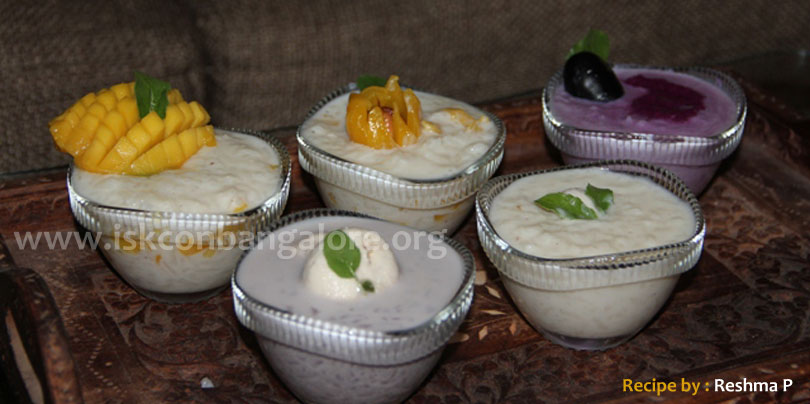
Recipe for Chida-dahi

Recipe for Chida-dahi


chida dahi
Soaking time: 1 hour

Serves: Each flavored portion serves 3-4

Ingredients:

Chida [thick rice flakes]: Washed in water. Soaked in milk for an hour 350 gms
Milk: Boiled 500 ml
Cardamom powder: 2 tsp
Sugar: 275 gms
Condensed milk (Amul Mithai Mate): 6 tbsps (for rice flakes soaked in milk)
Curds: Beaten 500 ml
Honey: 3 tbsps (for rice flakes soaked in milk)
For flavoring:

Jamun: Puree 2 tbsps
Jackfruit: Diced 2 tbsps
Mango: Diced 2 tbsps
Banana: Mashed 2 whole
Rasgulla: Pista stuffed 5-6
Method

For milk soaked rice flakes:

Soak rice flakes in very hot milk for an hour along with sugar and cardamom powder.
Once the rice flakes soaked in milk have come to room temperature add condensed milk, curds and honey to it. Mix well to combine. At this point we need to divide the chida mix into 4 equal portions for flavoring.
Now add each of the fruits (mango, jackfruit, banana and jamun puree) into each of the portions i.e., each fruit gets one portion of rice flake mix. Mix well to combine.
You can drop in some pista stuffed rasgullas in one of the portions and serve cold.

Festival of Punishment

The Festival of Punishment


The Supreme Personality of Godhead, Sri Krishna, appeared as Sri Chaitanya Mahaprabhu at Sridhama Mayapura (a quarter in the city of Navadvipa) in Bengal, in the year 1486 AD. The purpose of His incarnation was to establish the Yuga-dharma – the congregational chanting of the holy names of the Lord. Lord Balarama appeared as Nityananda Prabhu, and many other eternal associates of the Lord appeared at that time to join His mission. Srila Raghunatha dasa Gosvami was one of them.

srila raghunatha dasa goswami

Srila Raghunatha dasa Gosvami was a devotee of the highest order. He displayed a spirit of renunciation and detachment from the material world at a very early age. He wanted to leave home and join Sri Chaitanya Mahaprabhu in His mission. But Chaitanya Mahaprabhu asked him not to do so and assured that Krishna would deliver him soon from the clutches of maya. Two years later, Nityananda Prabhu came to Panihati and stayed there. Raghunatha dasa, who was staying in the nearby village of Srikrishnapura took permission from his father Govardhan Mazumdar and went to Panihati to meet Nityananda Prabhu.

srila raghunatha dasa goswami

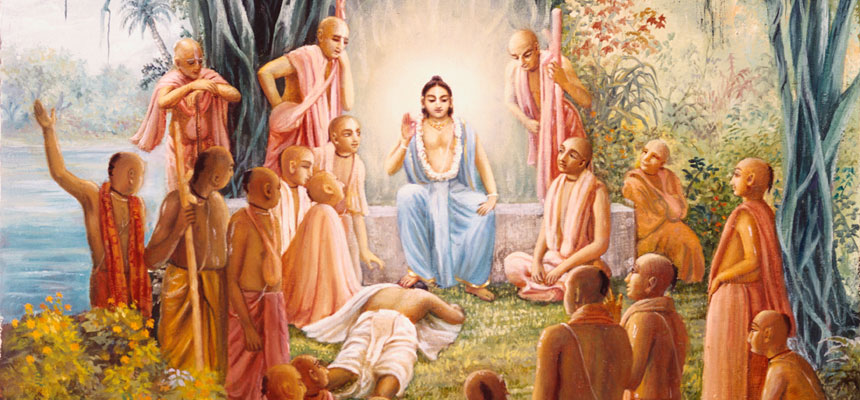
At Panihati, he saw Nityananda Prabhu sitting on a rock under a banyan tree on the banks of the River Ganges. He was surrounded by many devotees. Raghunatha dasa was hesitant to approach the Lord and paid obeisances from a distance. But some of the devotees noticed him and informed Nityananda Prabhu. Nityananda Prabhu called Raghunatha dasa and said “Raghunatha dasa! You are hiding like a thief. Now I have caught hold of you. Come here. I shall punish you today.’’ Then Lord Nityananda forcibly caught him and put His lotus feet on Raghunatha’s head. He ordered Raghunatha to celebrate a big festival and serve all the devotees – with yogurt and chipped rice.

Raghunatha dasa immediately sent his men to the nearby villages to purchase all kinds of eatables. They brought chipped rice (chida), milk, yogurt, sweetmeats, bananas, sugar and other eatables. The chipped rice was soaked in milk. Half of that was then mixed with yogurt, sugar and bananas. The remaining half was mixed with condensed milk and flavoured with clarified butter and camphor. All the devotees received two earthen pots, one with chipped rice mixed with yogurt and another with chipped rice mixed with condensed milk.

The Chida-dahi Mahotsava is celebrated every year in commemoration of this wonderful pastime. This festival is also known as Danda Mahotsava (the Festival of Punishment). It is celebrated on the thirteenth day of the bright moon in the month of Jyeshta (May-June). To this day, pilgrims visit Panihati to celebrate the Chida-dahi Festival.

Panihati Chida-dahi Utsava – June 7, 2017

Panihati Chida-dahi Utsava – June 7, 2017


Panihati is the name of a village located in the state of West Bengal, on the banks of River Ganges (10 miles north of Kolkata). It was one of the leading trade centres in earlier days when the river route was the main means of communication. A special rice variety called Peneti was imported at this place from Jessore in East Bengal. Probably the name Panihati might have been derived from this trade connection. Once upon a time this place was the centre of worship of the Buddhist Tantrics and the Kapalikas. But later, in the sixteenth century, when Sri Chaitanya Mahaprabhu appeared to propagate the Sankirtana Movement, Panihati became a major centre of the Gaudiya Vaishnavas. The residential quarters of Sri Raghava Pandita (one of the associates of Chaitanya Mahaprabhu) still exists in Panihati.

srila raghunatha dasa goswami

The Festival of Punishment

The Supreme Personality of Godhead, Sri Krishna, appeared as Sri Chaitanya Mahaprabhu at Sridhama Mayapura (a quarter in the city of Navadvipa) in Bengal, in the year 1486 AD. The purpose of His incarnation was to establish the Yuga-dharma – the congregational chanting of the holy names of the Lord. Lord Balarama appeared as Nityananda Prabhu, and many other eternal associates of the Lord appeared at that time to join His mission. Srila Raghunatha dasa Gosvami was one of them.

Srila Raghunatha dasa Gosvami was a devotee of the highest order. He displayed a spirit of renunciation and detachment from the material world at a very early age. He wanted to leave home and join Sri Chaitanya Mahaprabhu in His mission. But Chaitanya Mahaprabhu asked him not to do so and assured that Krishna would deliver him soon from the clutches of maya. Two years later, Nityananda Prabhu came to Panihati and stayed there. Raghunatha dasa, who was staying in the nearby village of Srikrishnapura took permission from his father Govardhan Mazumdar and went to Panihati to meet Nityananda Prabhu.

srila raghunatha dasa goswami

At Panihati, he saw Nityananda Prabhu sitting on a rock under a banyan tree on the banks of the River Ganges. He was surrounded by many devotees. Raghunatha dasa was hesitant to approach the Lord and paid obeisances from a distance. But some of the devotees noticed him and informed Nityananda Prabhu. Nityananda Prabhu called Raghunatha dasa and said “Raghunatha dasa! You are hiding like a thief. Now I have caught hold of you. Come here. I shall punish you today.’’ Then Lord Nityananda forcibly caught him and put His lotus feet on Raghunatha’s head. He ordered Raghunatha to celebrate a big festival and serve all the devotees – with yogurt and chipped rice.

Raghunatha dasa immediately sent his men to the nearby villages to purchase all kinds of eatables. They brought chipped rice (chida), milk, yogurt, sweetmeats, bananas, sugar and other eatables. The chipped rice was soaked in milk. Half of that was then mixed with yogurt, sugar and bananas. The remaining half was mixed with condensed milk and flavoured with clarified butter and camphor. All the devotees received two earthen pots, one with chipped rice mixed with yogurt and another with chipped rice mixed with condensed milk.

The Chida-dahi Mahotsava is celebrated every year in commemoration of this wonderful pastime. This festival is also known as Danda Mahotsava (the Festival of Punishment). It is celebrated on the thirteenth day of the bright moon in the month of Jyeshta (May-June). To this day, pilgrims visit Panihati to celebrate the