Plz click this ad to support us

Click to Shop Online Now!

Showing posts with label post. Show all posts

The Science of Mandukya Upanishad

In the series ‘The Science of Upaniṣads’, it is Māṇḍūkya (माण्डूक्य) Upaniṣad that we now take up for study and rational review; this is the sixth in the series of eleven Upaniṣads. Māṇḍūkya belongs to Atharva Veda, together with two other Principal Upaniṣads, Muṇḍaka and Praśna. What the word Māṇḍūkya signifies is not definitely known; in the study of the Upaniṣad it is not significant either.


Māṇḍūkya is the smallest of the eleven Principal Upaniṣads under our review; it has only 12 verses, numbered serially from 1 to 12. Nevertheless, it is the tersest of all, expounding in a unique manner the nature of shining of Ātmā in beings, with particular importance to the aspect of CHIT (consciousness). It uncovers four distinct modes of expression of CHIT.


Brevity of the Upaniṣad is an indication of the terseness in contents presentation, warranting detailed study of each verse. However, before moving on to the verses, we may recall our declared adherence to the rational path in the study of Upaniṣads. This may at times entail departure from conventional understanding and teaching by theologians and spiritual luminaries; in such cases the views expressed here may be appreciated with a rational approach befitting this age of scientific spirit. In our study, we shall also pursue our commitment to look for and abide by the consistency of teachings in all the Principal Upaniṣads taken together, which is essential for comprehensive understanding of their philosophy.


Let us now see the first verse:

ओमित्येतदक्षरमिदं सर्वं तस्योपव्याख्यानं भूतं भवद्भविष्यदिति सर्वमोङ्कार एव | यच्चान्यत् त्रिकालातीतं तदप्योङ्कार एव || 1 ||

omityetadakṣaramidaṃ sarvaṃ tasyopavyākhyānaṃ bhūtaṃ bhavadbhaviṣyaditi sarvamoṅkāra eva yaccānyat trikālātītaṃ tadapyoṅkāra eva. (1)

Word meaning: om- Om; iti- known as; etat- this; akṣaram- syllable; idaṃ- here, this; sarvaṃ- all; tasya- its; upavyākhyānaṃ- explanation, interpretation (physical translation, which is verily manifestation); bhūtaṃ- past; bhavat- present; bhaviṣyat- future; eva- verily; yat- which, what; ca- and; anyat- others; trikāla- past, present and future taken together, atītaṃ- beyond, transcending; tat- that; api- also.

Verse meaning: ‘All this is the syllable known as ‘Om’, (rather) its manifestation. Everything in the past, present and future is verily Om; if anything is there transcending these three expressions of time, then, that too is verily ‘Om’.

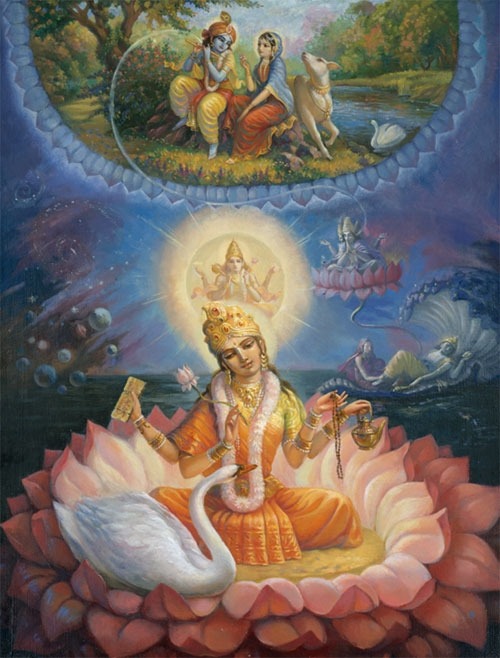
In verses 2.23.2 and 2.23.3 of Chāndogya Upaniṣad it is said that Vedas issued forth on account of intense meditation by Prajāpati on the worlds; in the same manner the three words ‘bhūḥ, bhuvaḥ, svaḥ (bhur, bhuva, sva)’ issued forth from the Vedas; and ‘Om’ issued forth from these three words, by intense meditation. The implication is that the principle of ‘Om’ was reached by successive intense meditations on the worlds, the Vedas and the three words of ‘bhūḥ, bhuvaḥ, svaḥ’. ‘Om’ is thus the ultimate essence of the worlds; the said meditations indicate a churning process to bring forth that essence, like the churning of Kṣīra Sāgara for obtaining the mythological amṛta, wherein Kṣīra Sāgara represents the universe.

Disappearance Day of Sri Kholaveca Sridhara Pandita ~ 7th June 2017

Kholaveca Sridhara Thakura lived just on the border of Nadia. He maintained himself by selling bananas, vegetables, banana leaves and cups.

Image result for Kholavecha Shridhara

khola-becataya khyatah panditah shridharo dvijah
asid vraje hasya-karo yo namna kusumasavah
   (Gaura-ganoddesha-dipika 133) Shridhara Pandit
Shridhara Pandit was a resident of Navadwip. Navadwip is composed of nine islands, of which the central island is known as Antardwipa. He used to live at the northern extremity of Mayapur and to the southeast of the Chand Kazi’s samadhi, in the place that now goes by the name of Shridhara Angan. During his lifetime, it was a banana orchard...(In the wallpaper: Shridhara Pandit's home, Shri Mayapur dham, banana barks).


   One of the twelve Gopals in Krishna lila was named Kusumasava. He appeared in Gaura-lila as Shridhara Pandit, who was given the nickname khola-becha, “bark-seller.”

   Shridhara Pandit was a resident of Navadwip. Navadwip is composed of nine islands, of which the central island is known as Antardwipa. He used to live at the northern extremity of Mayapur and to the southeast of the Chand Kazi’s samadhi, in the place that now goes by the name of Shridhara Angan. During his lifetime, it was a banana orchard, which nowadays is no longer the case, at least not to our mortal eyes. During this incarnation, Shridhara played the role of a poor Brahmin who made his living selling the produce of his banana garden. In order to keep the memory of Shridhara Pandit alive, the founder of the world-wide Chaitanya and Gaudiya Maths, Nitya-lila-pravishta Om Vishnupada Shrila Bhaktisiddhanta Saraswati Goswami Prabhupada, discovered and revealed this site of Chaitanya Mahaprabhu’s pastimes. Deity worship was established there and it continued until after Shrila Bhaktisiddhanta Saraswati Goswami Thakur’s disappearance. Now, because of problems with local people, the place is once again losing its beauty. Even so, during the Navadwip parikrama, Devotees still pay their obeisances at that spot to the memory of Shridhara Pandit.

   Shrila Bhaktivinoda Thakur has written as follows in his Nabadvipa-dhama-mahatmya: “Shridhara Pandit’s home comes after the weavers’ neighborhood. Gauranga Mahaprabhu ended the kirtan there.” Nityananda Prabhu says the following to Jiva Goswami:

   “Out of His mercy, Mahaprabhu Gauranga Hari would end the kirtan here so that the Devotees could rest. It is therefore known as vishrama-sthana, or the Lord’s place of rest. So let us also repose

Disappearance Day of Sri Mukunda Datta ~ 7th June 2017

Mukunda Datta, the son of Vasudeva Datta, was a classmate of Lord Caitanya’s. Mukunda Datta had a melodious voice, and he knew the intricacies of musical meters and ragas.

Mukunda Datta

 Shri Mukunda Datta was Shri Nimai Pandit's classmate at Ganga's Dasa's tol (school). Mukunda had a melodious voice and he knew the intricacies of musical meters and ragas. His sweet kirtana would please all the Vaishnavas at Navadwipa.Tuning in to Lord Gaura's heart, he would sing songs matching Lord Gauranga's feelings. Lord Chaitanya took sannyasa amidst Mukunda's kirtana. He served Shri Chaitanya in Puri as one of the Lord's humblest followers.

   Once at the house of Shrivasa Pandit Lord Chaitanya blessed all the Devotees except Mukunda. Mahaprabhu overlooked him because he had offended Bhakti Devi (who gives devotional service). Mukunda placed her on an equal level with karma, jnana, or even Mayavada philosophy whenever he talked to followers of those paths. Acting like a chameleon, Mukunda would glorify bhakti to bhaktas, and then debate useless mundane topics with karmis (nondevotees). And with Mayavadis he discussed impersonalism.
   Mukunda chose suicide as atonement for his serious offense to Bhakti Devi. He asked Lord Chaitanya if he would again receive His mercy in a future life. "You will receive My mercy," said Lord Chaitanya, "after passing one million births."

   Happy to know he would someday get Mahaprabhu's mercy, Mukunda jumped up and down shouting, "Only a million births, only a million births!"

   Lord Chaitanya's heart melted upon seeing Mukunda's devotion and determination. The Lord blessed and accepted Mukunda, "By your faith and conviction in My words all your offenses have been immeditately destroyed."

   In Krishna lila he is Madhukantha, a person with a honey sweet throat, a sweet singer. His samadhi is located within the 64 Samadhis Area.

Why Snana Yatra is Celebrated?

Image result for snana yatra

A special bath of Jagannath takes place on the Purnima of Jyestha month (Devasnan Purnima), to commemorate the appearance day of Lord Jagannath.

According to Skanda Purana when Raja Indradyumna installed the wooden deities he arranged this bathing ceremony. This day considered to be the birth-day of Lord jagannath. Held in the full-moon day of the month of Jyestha this festival is also simultaneously held in all other important Puri, it attracts thousands of visitors and pilgrims from all over the country.
'Niladri Mohadaya', a religious text written in Orissan (Oriya) records the rituals of the festival. Sriharsa in his 'naisadhiya Charita' (XV.89) also refers to this festival of Purushottama. This bathing ceremony has a speciality. As this festival does not find mention in the early religious texts, it is believed to be a tribal ceremony. Lord.Jagannath in His early form was being worshipped as Nilamadhava by a Savara chief called Viswabasu. The story is nicely told in the drama Jagannath Priyan natakam. Till now it is the Daitas and Savars (tribals) who have the exclusive right to conduct the festival. The tribals called Saoras (of southern Orissa) still perform a rite to bath their Deities ceremonially on the last day of the month of Jyestha. For this they collect water from remote Jungles where it remains untouched even by the shadow of the animals.

On the previous day of Snana Yatra the images of Jagannath, Balabhadra and Subhadra along with the image of Sudarshana are ceremonially brought out from the sanctum in a procession to the Snana-vedi (Bathing pandal). This special pandal in the temple precinct of Puri is called Snana Mandap. It is at such a height that visitors standing outside the temple also gate a glimpse of the Deities.
On the fourteenth day (Chaturdashi - the day before the bathing - Purnima) when the Deities are taken out in procession, the whole process is called Pahandi or Pahandi vijay. Scholars have given different interpretations of the term ('Pahandi'). Some opine that it has been derived from the term 'Praspanda' meaning movement. Some others are inclined to interpret it as derivation from Pandya vijaya.

For the festival the the Snana Vedi (bathing platform) is well decorated with traditional paintings of trees and gardens. Flags and toranas (arches strung with mango leaves) are also put up. The Deities are profusely decorated with flowers. All kinds of perfumes such as Dhupa (incense), Aguru (oils) etc. are then offered. As the 'Pahandi' of the Deities takes place to the accompaniment of music and beating of various indigenous drums. Thousands of devotees jostle and crave for a look at the Deities in procession.


In Puri the bathing procedure is as follows: After Mangala Arati, the Suaras and Mahasuaras go in a ceremonial procession to fetch water from Suna Kua (Golden well) in one hundred and thirty, vessels of copper and gold. All of them cover their mouths with a piece of cloth so as not to contaminate it even with their breath. Then all the vessels filled with water are preserved in the Bhoga Mandap. The Palla pandas (a class of Brahmin priests) then purify the water with Haridra (turmeric), Java (whole rice), Benachera, Chandan, Aguru, flowers, perfumes and medicinal herbs.
The bathing festival takes place during the morning hours of the purnima tithi. The filled vessels are carried from Bhoga Mandap to the Snana Vedi by the Suaras in a long single-line procession. This

Snana Yatra ~ 9th June 2017

On this full-moon day, sixteen days before Ratha- yatra, Lord Jagannatha is bathed. He becomes sick and is confined to rest for fourteen days. He is then offered special care until He comes out for Ratha-yatra.

Image result for snana yatra

A special bath of Jagannath takes place on the Purnima of Jyestha month (Devasnan Purnima), to commemorate the appearance day of Lord Jagannath.
According to Skanda Purana when Raja Indradyumna installed the wooden deities he arranged this bathing ceremony. This day considered to be the birth-day of Lord jagannath. Held in the full-moon day of the month of Jyestha this festival is also simultaneously held in all other important Puri, it attracts thousands of visitors and pilgrims from all over the country.

'Niladri Mohadaya', a religious text written in Orissan (Oriya) records the rituals of the festival. Sriharsa in his 'naisadhiya Charita' (XV.89) also refers to this festival of Purushottama. This bathing ceremony has a speciality. As this festival does not find mention in the early religious texts, it is believed to be a tribal ceremony. Lord.Jagannath in His early form was being worshipped as Nilamadhava by a Savara chief called Viswabasu. The story is nicely told in the drama Jagannath Priyan natakam. Till now it is the Daitas and Savars (tribals) who have the exclusive right to conduct the festival. The tribals called Saoras (of southern Orissa) still perform a rite to bath their Deities ceremonially on the last day of the month of Jyestha. For this they collect water from remote Jungles where it remains untouched even by the shadow of the animals.

On the previous day of Snana Yatra the images of Jagannath, Balabhadra and Subhadra along with the image of Sudarshana are ceremonially brought out from the sanctum in a procession to the Snana-vedi (Bathing pandal). This special pandal in the temple precinct of Puri is called Snana Mandap. It is at such a height that visitors standing outside the temple also get a glimpse of the Deities.

Image result for snana yatra

On the fourteenth day (Chaturdashi – the day before the bathing – Purnima) when the Deities are taken out in procession, the whole process is called Pahandi or Pahandi vijay. Scholars have given different interpretations of the term ('Pahandi'). Some opine that it has been derived from the term 'Praspanda' meaning movement. Some others are inclined to interpret it as derivation from Pandya vijaya.
For the festival the the Snana Vedi (bathing platform) is well decorated with traditional paintings of trees and gardens. Flags and toranas (arches strung with mango leaves) are also put up. The Deities are profusely decorated with flowers. All kinds of perfumes such as Dhupa (incense), Aguru (oils) etc. are then offered. As the 'Pahandi' of the Deities takes place to the accompaniment of music and beating of various indigenous drums. Thousands of devotees jostle and crave for a look at the Deities in procession.

In Puri the bathing procedure is as follows: After Mangala Arati, the Suaras and Mahasuaras go in a ceremonial procession to fetch water from Suna Kua (Golden well) in one hundred and thirty, vessels of copper and gold. All of them cover their mouths with a piece of cloth so as not to contaminate it even with their breath. Then all the vessels filled with water are preserved in the Bhoga Mandap. The Palla pandas (a class of Brahmin priests) then purify the water with Haridra (turmeric), Java (whole

The Deliverance of Lord Śiva


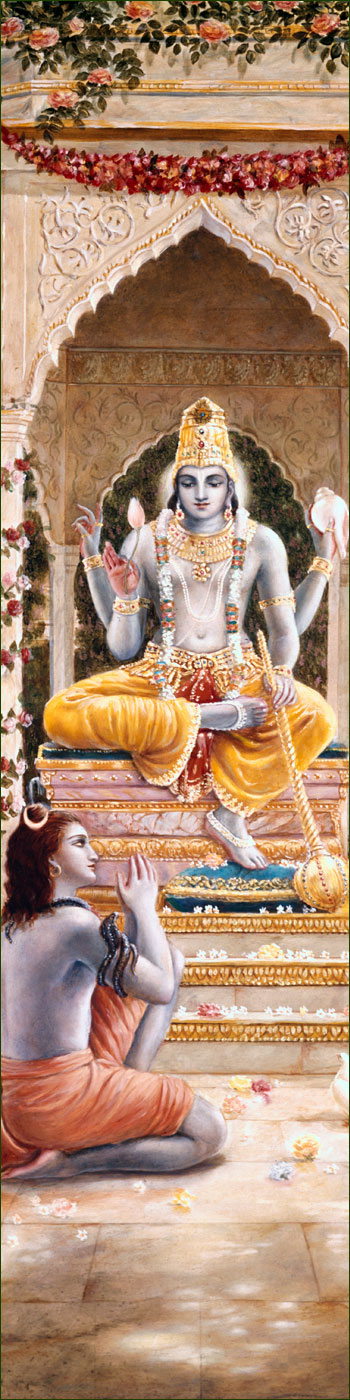
As a great devotee of Kṛṣṇa, King Parīkṣit was already liberated, but for clarification he was asking various questions of Śukadeva Gosvāmī. In the previous chapter, King Parīkṣit's question was, "What is the ultimate goal of the Vedas?" And Śukadeva Gosvāmī explained the matter, giving authoritative descriptions from the disciplic succession, beginning with Sanandana down to Nārāyaṇa Ṛṣi, Nārada, Vyāsadeva, and then he himself. The conclusion was that devotional service, or bhakti, is the ultimate goal of the Vedas. A neophyte devotee may question, "If the ultimate goal of life, or the conclusion of the Vedas, is to elevate oneself to the platform of devotional service, then why is it observed that a devotee of Lord Viṣṇu is generally not very prosperous materially, whereas a devotee of Lord Śiva is found to be very opulent?" In order to clarify this matter, Parīkṣit Mahārāja asked Śukadeva Gosvāmī: "My dear Śukadeva Gosvāmī, it is generally found that those who engage in the worship of Lord Śiva, whether in human, demoniac, or demigod society, become very opulent materially, although Lord Śiva himself lives just like a poverty-stricken person. On the other hand, the devotees of Lord Viṣṇu, who is the controller of the goddess of fortune, do not appear to be very prosperous, and sometimes they are even found to be living without any material opulence at all. Lord Śiva lives underneath a tree or in the snow of the Himalayan Mountains. He does not even construct a house for himself, but still the worshipers of Lord Śiva are very rich. Kṛṣṇa, or Lord Viṣṇu, however, lives very opulently, whether in Vaikuṇṭha or in this material world, but His devotees appear to be poverty-stricken. Why is this so?"


Mahārāja Parīkṣit's question is very intelligent. The two classes of devotees, namely the devotees of Lord Śiva and the devotees of Lord Viṣṇu, are always in disagreement. Even today in India these two classes of devotees still criticize each other, and especially in South India, the followers of Rāmānujācārya and the followers of Śaṅkarācārya hold occasional meetings for understanding the Vedic conclusion. Generally, the followers of Rāmānujācārya come out victorious in such meetings. So Parīkṣit Mahārāja wanted to clarify the situation by asking this question of Śukadeva Gosvāmī. That Lord Śiva lives as a poor man although his devotees appear to be very opulent, whereas Lord Kṛṣṇa or Lord Viṣṇu is always opulent, and yet His devotees appear to be poverty-stricken, is a situation which appears contradictory and puzzling to a discriminating person.


Lord Shiva & VishnuŚukadeva Gosvāmī began to reply to King Parīkṣit's inquiry about the apparent contradictions regarding the worship of Lord Śiva and that of Lord Viṣṇu. Lord Śiva is the master of the material energy. The material energy is represented by goddess Durgā, and Lord Śiva happens to be her husband. Since goddess Durgā is completely under the subjugation of Lord Śiva, it is to be understood that Lord Śiva is the master of this material energy. The material energy is manifested in three qualities, namely goodness, passion and ignorance, and therefore Lord Śiva is the master of these three qualities. Although he is in association with these qualities for the benefit of the conditioned soul, Lord Śiva is the director and is not affected. Although the conditioned soul is affected by the three qualities, Lord Śiva, because he is the master of these qualities, is not affected by them.

From the statements of Śukadeva Gosvāmī we can understand that the effects of worshiping different demigods are not, as some less intelligent persons suppose, the same as the effects of worshiping Lord Viṣṇu. He clearly states that by worshiping Lord Śiva one achieves one reward, whereas by worshiping Lord Viṣṇu one achieves a different reward. This is also confirmed in the Bhagavad-gītā: Those who worship the different demigods achieve the desired results which the respective demigods can reward. Similarly, those who worship the material energy receive the suitable reward for such activities, and those who worship the pitās receive similar results. But those who are engaged in devotional service or worship of the Supreme Lord, Viṣṇu or Kṛṣṇa, go to the Vaikuṇṭha planets or Kṛṣṇaloka. One cannot approach the transcendental region or paravyoma, the spiritual sky, by worshiping Lord Śiva or Brahmā or any other demigod.

Since this material world is a product of the three qualities of material nature, all varieties of manifestations come from those three qualities. With the aid of materialistic science, modern civilization has created many machines and comforts of life, and yet they are only varieties of the interactions of the three material qualities. Although the devotees of Lord Śiva are able to obtain many material acquisitions, we should know that they are simply collecting products manufactured by the three qualities. The three qualities are again subdivided into sixteen, namely the ten senses (five working senses and the five knowledge-acquiring senses), the mind, and the five elements (earth, water, air, fire and sky). These sixteen items are further extensions of the three qualities. Material happiness or opulence means gratification of the senses, specifically the genitals, the tongue and the mind. By exercising our minds we create many pleasurable things just for enjoyment by the genitals and the tongue. The opulence of a person within this material world is estimated in terms of his exercise of the genitals and the tongue, or, in other words, how well he is able to utilize his sexual

Krishna story: How Prahlada Became a Devotee of Nrsimhadeva

Krishna story: How Prahlada Became a Devotee of Nrsimhadeva

This section of the Hari-bhakti-vilasa 14.418-441, (the glories of Nrsimha-caturdasi) quoting from Brhan Nrsimha Purana , describes who Prahlada Maharaja was in his previous life and how he became a Narasimha Bhakta.
Prahlada said: O Supreme Lord! I bow down to You. O Lord Nrsimhadeva, I offer my obeisances to You. I am Your devotee. O Lord of lords, I now express to You my heartfelt inquiry. O Lord, how did I develop such intense devotion for You? O my Lord, kindly tell me-how did I become Your exalted devotee?

Image result for narasimha prahlada

Lord Narasimhadeva said: O greatly learned one! O my son, listen carefully as I explain to you the reason for your devotion to Me that has made you very dear to Me.
In the ancient times, you were born as a brahmana but you did not study any of the scriptures. Your name was Vasudeva and you became attached to a prostitute.
In that birth, you became so attached to a prostitute that you did not bother to perform any pious activity, except for a single vow in relation to Me. As a result of observing that vow, you developed exalted devotion for Me.

Prahlada then said: O Lord Nrsimhadeva! O Acyuta! O Supreme Lord, who was my father in that lifetime? What was my duty? How did I observe Your vow, even though I was attached to a prostitute? Kindly explain all this to me in detail.
Lord Nrsimhadeva said: In ancient times, there was a brahmana who was well-versed in the Vedic literature. He lived in the city of Avantipura and was known as Vasu Sarma.
This pious brahmana used to perform fire sacrifice every day. He was very expert in performing all kinds of Vedic rituals and as such, he would satisfy the best of demigods by performing the agnistoma sacrifice. In that state of living, he did not commit any sinful activity.

His wife was very pious and humble. She was famous throughout the three worlds. She was chaste, expert in performing all kinds of pious activities, and always eager to serve her husband.
That exalted brahmana begot five sons within the womb of his wife. These sons were very pious, learned, and devoted to their father. Among them, you were the youngest and you became attached to a prostitute.
Due to being attached to a prostitute, you became accustomed to drinking wine and performing other sinful activities, so that you never engaged in the study of the Vedas.
You spent most of your time at the house of the prostitute. One day, however, you and her quarreled.
Because of that quarrel, you missed your meal that day and as a result, you unknowingly observed a sacred vow in relation to Me.
Because of that quarrel with the prostitute, you did not sleep the entire night. The prostitute also did not eat anything, nor did she sleep that night in your association.

Because of unknowingly observing this vow in relation to Me, throughout the entire day and night, both of you became purified and accumulated heaps of pious merit.
On the strength of observing this vow, the demigods are able to enjoy their lives in the heavenly planets. In order to acquire the power to create, Brahma had observed this vow.
Being empowered due to observing this vow in relation to Me, Brahma was able to create all moving and non-moving living entities. Mahadeva also observed this vow, so that he could kill the great demon, Tripurasura. It is a fact that by the strength of this vow, Siva was able to kill that formidable demon.

Many other demigods, ancient sages, and learned and pious kings, had previously followed this great vow in relation to Me.
By the influence of this vow, all of them attained the perfection of life. The prostitute also became devoted to Me and thereafter enjoyed great happiness within the three worlds. My dear child, it is for this reason that this vow in relation to Me is celebrated through the three worlds.
This vow came into existence just to deliver such rascals. O Prahlada, by the strength of that vow, you came to render devotional service unto Me.
In her next life, the prostitute was born in heaven as an Apsara and after enjoying life there immensely, she entered My supreme abode. O Prahlada, you will also return to My abode and enter into intimate communion with Me.

In order to propagate devotional service to Me, you have incarnated without Me. After completing the task of preaching the glories of devotional service, you will again enter My eternal abode.
Those who observe this supreme vow in relation to Me will never return to this material existence, even in hundreds and millions of kalpas.

Hari-bhakti-vilasa 14.418-441
BY: SHYAMASUNDARA DASA

Pandava Nirjala Ekadashi ~ 5th June 2017

Nirjala Ekadasi occurs during the Jyestha (May/June) month and a description of this fantastically gracious day is found in the Brahma-vaivarta Purana.Once Bhimasena, the younger brother of Yudhisthira, asked the best of sages Srila Vyasadeva, "O great sage, yogi and knower of the Vedas, please hear my humble request. My elder brother Yudhisthira, mother Kunti devi, brothers Arjuna, Nakula and Sahadeva, and Draupadi fast completely on the Ekadasi day.

Yudhisthira is often encouraging me to fast and while I know it is  the injunction of the scriptures, and I have tried; I simply am unable to fast. My hunger is too great too bear fasting on every Ekadasi. I can give in charity, I can worship Lord Kesava but I cannot fast. Please instruct me how I can obtain the mercy of Sri Ekadasi.

Image result for Pandava Nirjala Ekadashi

"On hearing Bhima's pathetic entreaty, Sri Vyasadeva said, "O Bhima, if you want to go to the heavenly planets, avoiding the hellish condition, then you must refrain from eating on both Ekadasi days each month.

"Bhima interjected: 'O Vyasa Muni! It is impossible for me to fast on twenty-four Ekadasi's per year. What to speak of fasting day and night, I cannot tolerate my hunger for even a blink of an eye. The 'brika' fire of hunger is always present in my stomach, only voracious eating will quell this formidable foe in the form of craving. With great endeavor I may be able to fast one day a year…

"Sri Vyasadeva said: 'O my dear King, You have already heard from me about the Vedic religious principles and the duties of the human being. But in this age of Kali not everyone can follow these regulations, I know. Therefore I will tell of a sublime method by which all your desires will be fulfilled. This method is the concentrated essence of all the Puranas. Anybody who observes Ekadasi

Appearance Day of Srimati Gangamata Goswamini ~ 4th June 2017

Gangamata Goswami was the daughter of King Naresa Narayana of Bengal. From childhood she showed deep devotion to Krsna.

Gaudiya Vaishnavism has been blessed with several important women Gurus who have been empowered by Shri Gauranga Mahaprabhu to serve as spiritual ‘bridges’ in times when there have been long gaps in the disciplic succession.

Image result for Srimati Gangamata Goswami

After a year of this intense devotional activity, she was told by her spiritual master to live in Radha Kund with her spiritually advanced aunt and god-sister, Lakshmipriya, who regularly chanted three lakhs of naam every day. As a part of their regular spiritual practice, the two of them daily circumambulated Shri Govardhana Giri. (In the image: Radha Kund, Vrindavan).

   Such important figures have been Sita Thakurani, the wife of Shri Advaita Acharya; Janhava Thakurani, Lord Nityananda’s shakti; Hemlata Thakurani, the daughter of Shrinivas Acharya and a contemporary of Janhava Thakurani; Gaurangapriya the second wife and disciple of Shrinivas Acharya; Krishnapriya and Vishnupriya, two renunciate sisters, daughters and disciples of Narottama Das's chief disciple Ganganarayan Chakravarti; Ganga Mata Goswami, the daughter of the zamindar of Puntiya.

   The zamindar of Puntiya, Naresh Narayana, was influenced and blessed by Shrinivas Acharya and received the mercy of the Vaishnavas. He thus accepted Vaishnava dharma.

   His daughter Sachi devi was born in Puntiya which is in the Rajashahi district of present-day Bangladesh. From her early childhood, Sachi Devi was indifferent to family life and devoted to Krishna. Her parents saw this and wanted to see her married as soon as possible, but Sachi told them that she refused to accept any mortal as her husband. When she announced her determination to remain unmarried in this way, her parents could do nothing to change her mind. When her mother died, Sachi Devi left home and set out on a pilgrimage which led her first to Puri and then to Vrindavan.

   Sachi devi dasi received initiation from Shri Haridas Pandit Goswami, the great worshiper of Shri Govindaji in Vrindavan and began performing her bhajan in Vrindavan. Later she continued her sadhana at Radha Kunda. Gangamata Goswamini
Upon her arrival in Vrindavan Dhama, she met Shri Haridas Goswami and felt her entire pilgrimage
was fulfilled. She wanted to take initiation from him, but he hesitated at first because of her wealthy family background. Later, however, when he saw her asceticism and her unswerving determination to engage in pure devotional life, he gave her initiation in the eighteen-syllabled mantra. This event took place in the Govindaji Temple on the Chaitra Shukla Ekadashi. (Sri Govindaji Temple, Vrindavan).


   Upon her arrival in Vrindavan Dhama, she met Shri Haridas Goswami and felt her entire pilgrimage was fulfilled. She wanted to take initiation from him, but he hesitated at first because of her wealthy family background. Later, however, when he saw her asceticism and her unswerving determination to engage in pure devotional life, he gave her initiation in the eighteen-syllabled mantra. This event took place in the Govindaji Temple on the Chaitra Shukla Ekadashi.

   After having received her guru’s mercy, she began to engage in intense bhajana, subsisting through madhukari, i.e., by begging from door to door for food. After a year of this intense devotional activity, she was told by her spiritual master to live in Radha Kund with her spiritually advanced aunt and god-sister, Lakshmipriya, who regularly chanted three lakhs of naam every day. As a part of their regular spiritual practice, the two of them daily circumambulated Shri Govardhana Giri.

   After several years of such practice at Radha Kund, when Sachi had become very advanced in her devotional life, her Guru sent her to Purushottam Kshetra to revive and restore the home of Sarvabhauma Bhattacharya, which had fallen into disrepair. Obeying her Guru’s instructions, Sachi Devi went to Jagannath Puri and took the kshetra-sannyasa vow.

   Among others, King Mukundadeva of Jagannath Puri and a number of Jagannath's sevaites received diksha from her. She was also an eloquent speaker and explained Shrimad Bhagavatam for large audiences.

   On the day of Ganga Sagara she desired to bathe in the Ganges. That night the Ganges came from the lotus feet of Lord Jagannath to her ashram and allowed her to bathe. Entering Ganga devi's waters, she floated to the lotus feet of Jagannath Swami in Jagannath Puri. Early in the morning, when the pujaris unlocked the doors and opened the gates, they discovered her.

   Thinking she was a thief, they put her in jail. But Lord Jagannath seeing this mistake appeared in the dream to both the king and the head pujari, ordering them to immediately release Sachi devi from jail and to take initiation from her.
Gangamata Goswamini
In Jaipur there is a Deity called Shri Shyama Raya which used to be worshiped by a brahmin. One night the Deity appeared to the Brahmin in his dream and told him he should take Him to Puri and hand Him to Gangamata Goswamini. Following the order of the Deity, the Brahmin went to Puri and presented Shri Shyama Raya to her. On the order of Ganga mata Goswamini, the king renovated the old palace of Shri Sarvabhauma Bhattracharya and she then established Shri Shyama Raya, and He is still being worshiped there today. (In the image: Temple of Shyama Raya, Puri).

   The glories of Sachi devi dasi spread throughout Puri and Sachi devi dasi was hurriedly released by the order of Jagannath Swami. From that time onwards she became famous as Ganga-mata Goswamini.

   In Jaipur there is a Deity called Shri Shyama Raya which used to be worshiped by a brahmin. One night the Deity appeared to the Brahmin in his dream and told him he should take Him to Puri and hand Him to Gangamata Goswamini. Following the order of the Deity, the Brahmin went to Puri and presented Shri Shyama Raya to her. On the order of Ganga mata Goswamini, the king renovated the old palace of Shri Sarvabhauma Bhattracharya and she then established Shri Shyama Raya, and He is still being worshiped there today.

   Ganga Mata Goswamini was initiated in the line of Gauranga's shakti, Srila Gadadhara Pandit Goswami, by Haridas Goswami. This is described in the Chaitanya Charitamrita. Ananta Acharya was a disciple of Gadadhara Pandit. Pandit Haridas was the beloved disciple of Shri Ananta Acharya.

   According to Srila Bhakti Siddhanta Saraswati Thakur, Ananta Acharya was Sudevi, one of the eight principal Gopis. This is stated in the Gaura-ganoddesha-dipika, verse 165, as follows: ‘Ananta Acharya Goswami was formerly Sudevi-gopi in Vraja [Vrindavan].’

   According to the disciplic succession descending from him at the famous Ganga-mata monastery, he is known as Vinoda manjari. One of his disciples was Haridas Pandit Goswami, who is also known as Shri Raghu Gopal and as Shri Rasa manjari. He had two important disciples: Lakshmipriya and her niece, Ganga Mata, daughter of the Raja of Puntiya.

http://www.srigaurangashram.in
Gangamata Goswamini
Thinking she was a thief, they put her in jail. But Lord Jagannath seeing this mistake appeared in the dream to both the king and the head pujari, ordering them to immediately release Sachi devi from jail and to take initiation from her. (In the wallpaper: Lord Sri Jagannath).

Ganga Puja ~ 4th June 2017

The appearance anniversary of Ganga Devi, the goddess of the River Ganges.

This is literally the "birthday or descent of mother Ganges – Ganga Ma". Throughout india this festival lasts ten days beginning on the Amavasya (dark moon night) and going through to the dasami tithi (tenth phase of the Moon, the day before Pandava Nirjal Ekadasi)


Image result for ganga puja iskcon
"Festivals connected with rivers are essentially bathing festivals. Ganga Dussehra is celebrated on the tenth day of Jyeshtha. River Ganga is worshipped as a mother as well as a Goddess, particularly by people of Uttara Pradesh, Bihar, and Bengal through which the river flows. On this day, if a devotee is unable to visit and bathe in the river Ganga, then Ganga jal (water) kept in most Hindu homes is used for purification. A bath in the river is said to purify the bather of all sins. The Ganga is revered all over India even in places far from its course.

Initially, river Ganga flowed in the heavens. She was brought down to earth by the severe penances of the sage Bhagiratha and that is why she is also called Bhagirathi. According to the story, of the descent of the Ganga, once a number of demons were harassing the hermits by disturbing them in their ascetic duties. During the day, they would be chased into the ocean. But in the darkness of the night, they would emerge from the ocean and start harassing the hermits again. In desperation the hermits appealed to Rishi Agastya. Agastya, known for his gastronomic powers, drank all the water of the ocean. Though this was done in good faith, it resulted in depriving the world of the water needed for sustenance and the earth became parched and dry. Bhagiratha brought this drought to and end.

According to the legend, King Sagara of the Ikshvaku dynasty ruling at Ayodhya in Uttar Pradesh had two queens, Keshani and Sumati, but neither had a child. Sagara performed severe austerities before his wives could produce sons. But whereas Keshani gave birth to a son called Asmajas, Sumati bore 60,000 sons. Sagara performed the Ashwamedha sacrifice to declare his suzerainty over the neighbouring kingdoms. According to the prevalent custom, the sacrificial horse was let loose and allowed to wander into the neighbouring kingdoms. If the horse was caught, a battle ensued and the outcome decided the winner. The 60,000 sons of Sagara were following the horse when they saw him enter a cavern where sage Kapila was meditating. Not seeing the horse in the cavern, they presumed that Kapila had captured it. They did not kill Kapila as he was a sage but they started disturbing his meditations. Annoyed at being disturbed, Kapila with a curse burnt the 60,000 sons of Sagara.


Time passed and later Bhagiratha, the great grandson of Sagara, chanced to come across the bones of his dead ancestors. He wanted to perform the shraddha of his ancestors but there was no water available for the ceremony. Agastya having drunk all the waters of the ocean, the country was passing through a severe drought. Bhagiratha prayed to Brahma, the Creator, to end the drought. Brahma asked him to pray to Vishnu, the Preserver, to allow the heavenly Ganga, issuing from His big toe, to

Five lessons to be learnt from the Festival of Punishment

Five lessons to be learnt from the Festival of Punishment


Detachment

Srila Raghunatha dasa Gosvami was the son of Govardhana Majumadara, a rich zamindar,  who was the younger brother of Hiranya Majumadara. Both Hiranya Majumadara and Govardhana Majumadara were so rich that their annual income amounted to Rs. 12,00,000 at that time. Practically all the brahmanas residing in Nadia were dependent on the charity of Hiranya and Govardhana.

In spite of this aristocratic family background, Raghunatha dasa was not interested in material pleasure. He was totally detached from the desire to enjoy the vast property of his father and luxurious family life as a householder. His only desire was to attain the lotus feet of Sri Chaitanya Mahaprabhu.

panihati1

Determination

Raghunatha dasa wanted to leave home and join Sri Chaitanya Mahaprabhu to serve His mission. But he was unable to do so. He tried many a time to run away from home. Seeing his tendency to leave home, his father and uncle engaged bodyguards to watch over him. However, he escaped in the darkness one day, but his father located him in a distant place and brought him back. This became almost a daily affair. Every time Raghunatha ran away from home, his father again brought him back.  But Raghunatha dasa was resolute in his attempts to take shelter of Sri Chaitanya Mahaprabhu.

Seeing this behavior of her son, Raghunatha dasa’s mother spoke to his father: “Our son has become mad. Just keep him by binding him with ropes.”

His father, being very unhappy, replied to her as follows:

“Raghunatha dasa, our son, has opulences like Indra, the heavenly King, and his wife is as beautiful as an angel. Yet all this could not tie down his mind. How then could we keep this boy home by binding him with ropes?”

Surrender


Raghunatha dasa learnt that Sri Nityananda Prabhu was staying with His associates in the village of Panihati. He decided to meet Lord Nityananda. Taking his father’s permission he reached Panihati. Lord Nityananda was sitting on a rock under a tree on the banks of the River Ganges and He was surrounded by many devotees. Seeing the effulgence of the Lord, Raghunatha dasa offered his

Lord Nityananda - The Merciful Avatar

Lord Nityananda - The Merciful Avatar


Who is Lord Nityananda?


Lord Nityananda is the eternal associate of Chaitanya Mahaprabhu, the Supreme Personality of Godhead. Chaitanya Mahaprabhu cannot be approached or understood without the mercy of Nityananda Prabhu, He serves as an intermediary between Mahaprabhu and His devotees. He is the second body of the Lord, manifesting as Balarama to Sri Krishna; Lakshmana to Sri Rama and Nityananda Prabhu to Chaitanya Mahaprabhu.

Nityananda Prabhu has the whitish complexion of Lord Balarama. He has a deep melodious voice, constantly singing the glories of Sri Krishna and carries a red stick with benedictions for the devotees, but feared by the demoniac. He has the mood of an avadhuta and He is so absorbed in love of Godhead.

Nityananda Prabhu was born in Ekachakra, a small village in present West Bengal, around the year 1474. His birth site is commemorated by a temple named Garbhavasa and is visited by pilgrims even today. His father, Hadai Ojha and mother Padmavati, were pious brahmanas originally from Mithila. Nityananda Prabhu was born on the auspicious thirteenth day of the bright fortnight of the month of Magha. As a child, Nitai loved to enact the pastimes of Sri Krishna and Sri Rama.

The village of Ekachakra was completely absorbed in the love of little Nitai, where He spent the first 12 years of His earthly life. In the 13th year, a travelling sannyasi, enchanted by Nitai’s devotion and service, requested Nitai from His parents, as a travelling companion. His parents, bound by Vedic culture, could not refuse the request of a guest and reluctantly parted with Nitai.

Nityananda Prabhu met Chaitanya Mahaprabhu in 1506, when He was 32 years old and Chaitanya 20 years. Nityananda Prabhu in His role as the original spiritual master was instrumental in spreading the yuga dharma of sankirtana all over the Gauda desh (Bengal, Odisha). His mercy knew no bounds, and fortunate were the people who tasted the nectar of His instructions.

He married Jahnava devi and Vasudha, the two daughters of Suryadasa Sarakhel, who was the brother of Gauridasa Pandit (an intimate associate of Chaitanya Mahaprabhu and the spiritual master of the famous Shyamananda Pandit). Nityananda Prabhu had a son (Virabhadra) and a daughter (Gangadevi) from Vasudha.

Lord Nityananda wound up His earthly pastimes, by entering into the Deity of Krishna, known as Bankima Raya, not far from Ekachakra. Vaishnava acharyas emphatically state that people who try to understand Chaitanya Mahaprabhu without getting the mercy of Nityananda Prabhu will never succeed and one must pray very sincerely to Lord Nityananda Prabhu as the adi-guru (original spiritual master) to be delivered to the lotus feet of Sri Chaitanya Mahaprabhu

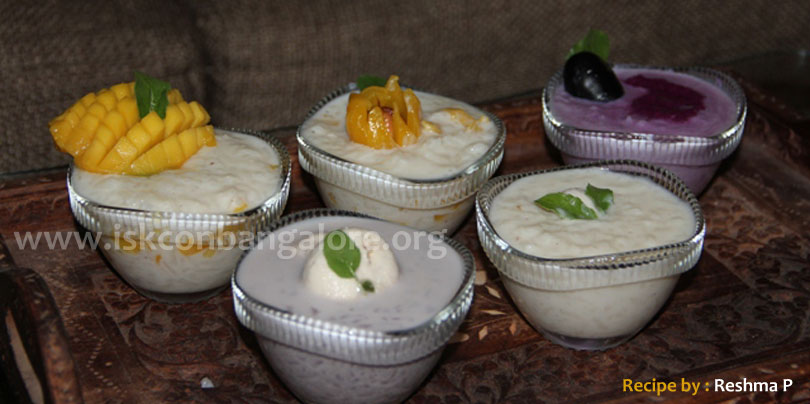
Recipe for Chida-dahi

Recipe for Chida-dahi


chida dahi
Soaking time: 1 hour

Serves: Each flavored portion serves 3-4

Ingredients:

Chida [thick rice flakes]: Washed in water. Soaked in milk for an hour 350 gms
Milk: Boiled 500 ml
Cardamom powder: 2 tsp
Sugar: 275 gms
Condensed milk (Amul Mithai Mate): 6 tbsps (for rice flakes soaked in milk)
Curds: Beaten 500 ml
Honey: 3 tbsps (for rice flakes soaked in milk)
For flavoring:

Jamun: Puree 2 tbsps
Jackfruit: Diced 2 tbsps
Mango: Diced 2 tbsps
Banana: Mashed 2 whole
Rasgulla: Pista stuffed 5-6
Method

For milk soaked rice flakes:

Soak rice flakes in very hot milk for an hour along with sugar and cardamom powder.
Once the rice flakes soaked in milk have come to room temperature add condensed milk, curds and honey to it. Mix well to combine. At this point we need to divide the chida mix into 4 equal portions for flavoring.
Now add each of the fruits (mango, jackfruit, banana and jamun puree) into each of the portions i.e., each fruit gets one portion of rice flake mix. Mix well to combine.
You can drop in some pista stuffed rasgullas in one of the portions and serve cold.

Festival of Punishment

The Festival of Punishment


The Supreme Personality of Godhead, Sri Krishna, appeared as Sri Chaitanya Mahaprabhu at Sridhama Mayapura (a quarter in the city of Navadvipa) in Bengal, in the year 1486 AD. The purpose of His incarnation was to establish the Yuga-dharma – the congregational chanting of the holy names of the Lord. Lord Balarama appeared as Nityananda Prabhu, and many other eternal associates of the Lord appeared at that time to join His mission. Srila Raghunatha dasa Gosvami was one of them.

srila raghunatha dasa goswami

Srila Raghunatha dasa Gosvami was a devotee of the highest order. He displayed a spirit of renunciation and detachment from the material world at a very early age. He wanted to leave home and join Sri Chaitanya Mahaprabhu in His mission. But Chaitanya Mahaprabhu asked him not to do so and assured that Krishna would deliver him soon from the clutches of maya. Two years later, Nityananda Prabhu came to Panihati and stayed there. Raghunatha dasa, who was staying in the nearby village of Srikrishnapura took permission from his father Govardhan Mazumdar and went to Panihati to meet Nityananda Prabhu.

srila raghunatha dasa goswami

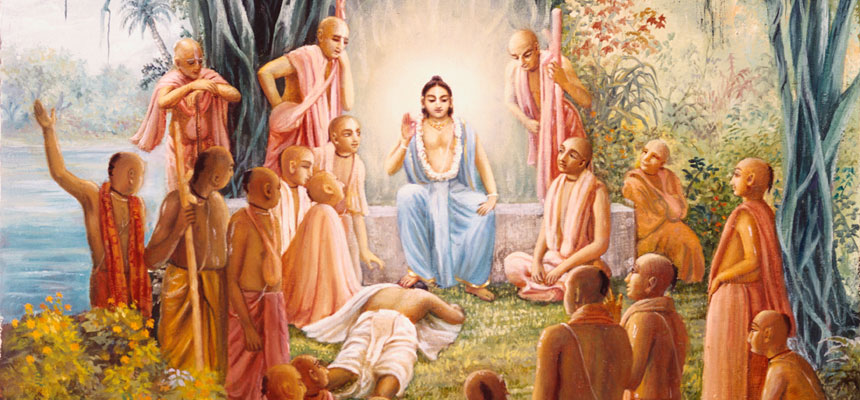
At Panihati, he saw Nityananda Prabhu sitting on a rock under a banyan tree on the banks of the River Ganges. He was surrounded by many devotees. Raghunatha dasa was hesitant to approach the Lord and paid obeisances from a distance. But some of the devotees noticed him and informed Nityananda Prabhu. Nityananda Prabhu called Raghunatha dasa and said “Raghunatha dasa! You are hiding like a thief. Now I have caught hold of you. Come here. I shall punish you today.’’ Then Lord Nityananda forcibly caught him and put His lotus feet on Raghunatha’s head. He ordered Raghunatha to celebrate a big festival and serve all the devotees – with yogurt and chipped rice.

Raghunatha dasa immediately sent his men to the nearby villages to purchase all kinds of eatables. They brought chipped rice (chida), milk, yogurt, sweetmeats, bananas, sugar and other eatables. The chipped rice was soaked in milk. Half of that was then mixed with yogurt, sugar and bananas. The remaining half was mixed with condensed milk and flavoured with clarified butter and camphor. All the devotees received two earthen pots, one with chipped rice mixed with yogurt and another with chipped rice mixed with condensed milk.

The Chida-dahi Mahotsava is celebrated every year in commemoration of this wonderful pastime. This festival is also known as Danda Mahotsava (the Festival of Punishment). It is celebrated on the thirteenth day of the bright moon in the month of Jyeshta (May-June). To this day, pilgrims visit Panihati to celebrate the Chida-dahi Festival.

Panihati Chida-dahi Utsava – June 7, 2017

Panihati Chida-dahi Utsava – June 7, 2017


Panihati is the name of a village located in the state of West Bengal, on the banks of River Ganges (10 miles north of Kolkata). It was one of the leading trade centres in earlier days when the river route was the main means of communication. A special rice variety called Peneti was imported at this place from Jessore in East Bengal. Probably the name Panihati might have been derived from this trade connection. Once upon a time this place was the centre of worship of the Buddhist Tantrics and the Kapalikas. But later, in the sixteenth century, when Sri Chaitanya Mahaprabhu appeared to propagate the Sankirtana Movement, Panihati became a major centre of the Gaudiya Vaishnavas. The residential quarters of Sri Raghava Pandita (one of the associates of Chaitanya Mahaprabhu) still exists in Panihati.

srila raghunatha dasa goswami

The Festival of Punishment

The Supreme Personality of Godhead, Sri Krishna, appeared as Sri Chaitanya Mahaprabhu at Sridhama Mayapura (a quarter in the city of Navadvipa) in Bengal, in the year 1486 AD. The purpose of His incarnation was to establish the Yuga-dharma – the congregational chanting of the holy names of the Lord. Lord Balarama appeared as Nityananda Prabhu, and many other eternal associates of the Lord appeared at that time to join His mission. Srila Raghunatha dasa Gosvami was one of them.

Srila Raghunatha dasa Gosvami was a devotee of the highest order. He displayed a spirit of renunciation and detachment from the material world at a very early age. He wanted to leave home and join Sri Chaitanya Mahaprabhu in His mission. But Chaitanya Mahaprabhu asked him not to do so and assured that Krishna would deliver him soon from the clutches of maya. Two years later, Nityananda Prabhu came to Panihati and stayed there. Raghunatha dasa, who was staying in the nearby village of Srikrishnapura took permission from his father Govardhan Mazumdar and went to Panihati to meet Nityananda Prabhu.

srila raghunatha dasa goswami

At Panihati, he saw Nityananda Prabhu sitting on a rock under a banyan tree on the banks of the River Ganges. He was surrounded by many devotees. Raghunatha dasa was hesitant to approach the Lord and paid obeisances from a distance. But some of the devotees noticed him and informed Nityananda Prabhu. Nityananda Prabhu called Raghunatha dasa and said “Raghunatha dasa! You are hiding like a thief. Now I have caught hold of you. Come here. I shall punish you today.’’ Then Lord Nityananda forcibly caught him and put His lotus feet on Raghunatha’s head. He ordered Raghunatha to celebrate a big festival and serve all the devotees – with yogurt and chipped rice.

Raghunatha dasa immediately sent his men to the nearby villages to purchase all kinds of eatables. They brought chipped rice (chida), milk, yogurt, sweetmeats, bananas, sugar and other eatables. The chipped rice was soaked in milk. Half of that was then mixed with yogurt, sugar and bananas. The remaining half was mixed with condensed milk and flavoured with clarified butter and camphor. All the devotees received two earthen pots, one with chipped rice mixed with yogurt and another with chipped rice mixed with condensed milk.

The Chida-dahi Mahotsava is celebrated every year in commemoration of this wonderful pastime. This festival is also known as Danda Mahotsava (the Festival of Punishment). It is celebrated on the thirteenth day of the bright moon in the month of Jyeshta (May-June). To this day, pilgrims visit Panihati to celebrate the

Why No Onion and Garlic?

Why we don’t eat onion and garlic?


Image result for onion garlic no

One of the most common questions asked to me is this: "Why don't you eat garlic and onions?" Here's my short answer: As a devotee of Krishna and a practicing Bhakti-yogi, I don't eat garlic and onions because they cannot be offered to Krishna.

Here's my longer answer: You may know that onions and garlic are botanical members of the alliaceous family (alliums) – along with leeks, chives and shallots.

According to Ayurveda, India's classic medical science, foods are grouped into three categories – sattvic, rajasic and tamasic – foods in the modes of goodness, passion and ignorance. Onions and garlic, and the other alliaceous plants are classified as rajasic and tamasic, which means that they increase passion and ignorance.

Those that subscribe to pure brahmana-style cooking of India, including myself, and Vaishnavas – followers of Lord Vishnu, Rama and Krishna – like to only cook with foods from the sattvic category. These foods include fresh fruits, vegetables and herbs, dairy products, grains and legumes, and so on. Specifically, Vaisnavas do not like to cook with rajasic or tamasic foods because they are unfit to offer to the Deity.

Rajasic and tamasic foods are also not used because they are detrimental to meditation and devotions. "Garlic and onions are both rajasic and tamasic, and are forbidden to yogis because they root the consciousness more firmly in the body", says well-known authority on Ayurveda, Dr. Robert E. Svoboda.

Some branches of western medicine say that the Alliums have specific health benefits; garlic is respected, at least in allopathic medical circles, as a natural antibiotic. In recent years, while the apparent cardiovascular implications of vegetable Alliums has been studied in some detail, the clinical implications of onion and garlic consumption from this point of view are still not well understood.

Nevertheless, there are still many adverse things to say about garlic and onions. Not so well known is the fact that garlic in the raw state can carry harmful (potentially fatal) botulism bacteria. Perhaps it is with an awareness of this that the Roman poet Horace wrote of garlic that it is “more harmful than hemlock".

It should be pointed out that Garlic and onion are avoided by spiritual adherents because they

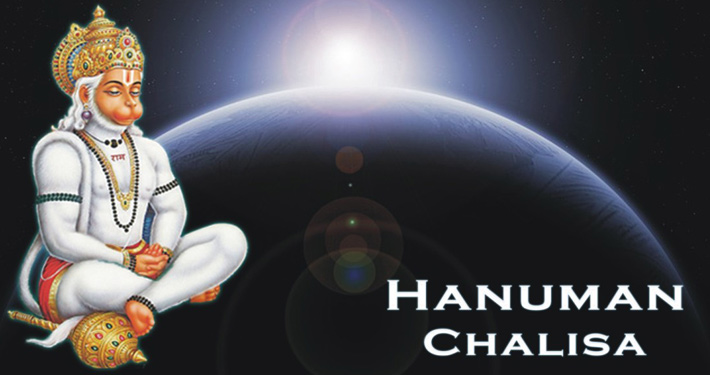
Hanuman Chalisa Predicts the Distance between Sun and Earth

Hanuman Chalisa predicts the distance between Sun and Earth


Hanuman Chalisa was composed by Gosvami Tulasidasa. He was a great devotee of Lord Ramachandra who lived in the 16th century. He composed the Rama-charita-manasa, the epic story of Lord Rama retold in the vernacular language. Many devotees regularly recite Hanuman Chalisa, a prayer glorifying Shri Hanuman, composed by this great saint and poet.

Hanuman-chalisa

It is believed that in one of these verses of Hanuman Chalisa, Tulasidasa had given an accurate calculation of the distance between the Sun and Earth.
The Quest of Astronomers to find the distance of Sun

The Greek Astronomers were known for their contribution to the scientific field in understanding the heavenly bodies.

    Archimedes, an ancient Greek Mathematician and Philosopher of the 3rd century BC, estimated the distance of Sun from Earth as 10000 times the radius of Earth.
    Later, Hipparchus (2nd century BC) gave an estimate of 490 times the radius of Earth.
    Ptolemy considered the distance to be 1210 times the radius of Earth.

However, Johannes Kepler (1571 – 1630), a German Mathematician and Astronomer realized that these estimates were significantly low. Kepler’s law of Planetary Motion allowed astronomers to calculate the relative distance of the planets from Sun. This was also aided by the invention of telescope in the beginning of the 17th century which helped them to get more accurate measurements.

However the most modern calculations in 20th century estimate the distance to be somewhere around 23455 times the radius of Earth (149,431,805 kms assuming radius of Earth to be 6371 kms).
Srila Prabhupada writes in one of his purports:

Modern scientific calculations are subject to one change after another, and therefore they are uncertain. We have to accept the calculations of the Vedic literature. These Vedic calculations are steady; the astronomical calculations made long ago and recorded in the Vedic literature are correct even now. Whether the Vedic calculations or modern ones are better may remain a mystery for others, but as far as we are concerned, we accept the Vedic calculations to be correct.
According to modern calculation:

Average distance between the Sun and Earth =149 million kms = 92 million miles.

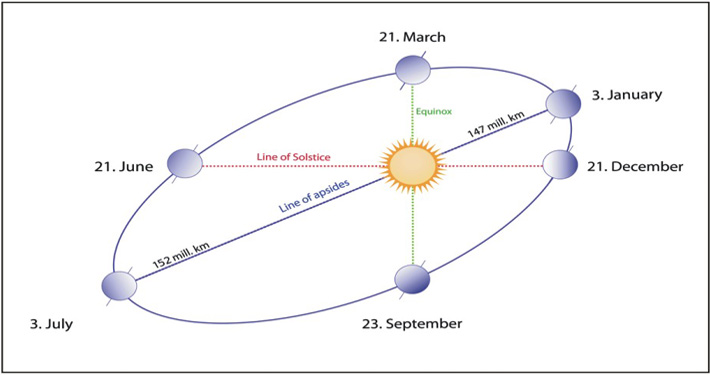
However, the orbit of the Earth is not a perfect circle, but an ellipse. Sometimes the Earth is closer to the Sun and sometimes it is farther.


distance-sun-moon

Shortest distance between Sun and Earth (perihelion) = 91 million miles = 147 million kms (early January)

Longest distance between Sun and Earth (aphelion) = 94.5 million miles = 152 million kms (early July)

It is surprising to note that Tulasidasa who lived in 16th century could give the most accurate

Rukmini Dvadasi & Why It's Celebrated.

Rukmini Dvadasi & Why It's Celebrated. 

Image result for rukmini krishna


Today marks the appearance anniversary of Rukmini Devi, one of Krishna's primary queens in Dwaraka. Rukmini Devi is the eternal consort of Krishna, the Supreme Personality of Godhead. She is the internal pleasure potency of the Lord. Whereas Srimati Radharani is Krishna’s consort in His childhood home of Vrindavana, Rukmini Devi is His chief queen in Dwaraka, His opulent capital. She was betrothed to the envious-minded Shishupala, but Krishna kidnapped her after she wrote Him a letter asking Him to do so. She is considered an expansion of the gopi (cowherd girl) Chandravali.

Dvadasi is the twelfth day of the waning or waxing moon (dva, "two," dasi, "tenth"). In the Vedic, lunar calendar, dvadasi follows Ekadasi, a day customarily set aside for exclusive focus on spiritual activity and fasting—at least from grains and beans. Fasting for Ekadasi is considered incomplete unless one breaks fast at the proper time the following day, dvadasi.

Krishna's pastimes with Rukmini Devi mentioned in Krishna, the Supreme Personality of Godhead, Chapters 52-54.


KB 52: Kṛṣṇa, the Raṇacora

CHAPTER FIFTY-TWO


When Mucukunda, the celebrated descendant of the Ikṣvāku dynasty, was favored by Lord Kṛṣṇa, he circumambulated the Lord within the cave and then came out. On coming out of the cave, Mucukunda saw that the human species had surprisingly been reduced in stature to pygmy size. Similarly, the trees had also been far reduced in size, and Mucukunda could immediately understand that the current age was Kali-yuga. Therefore, without diverting his attention, he began to travel

Chandan Yatra Narasimha Jayanthi Special

Chandan Yatra Narasimha Jayanthi Special 

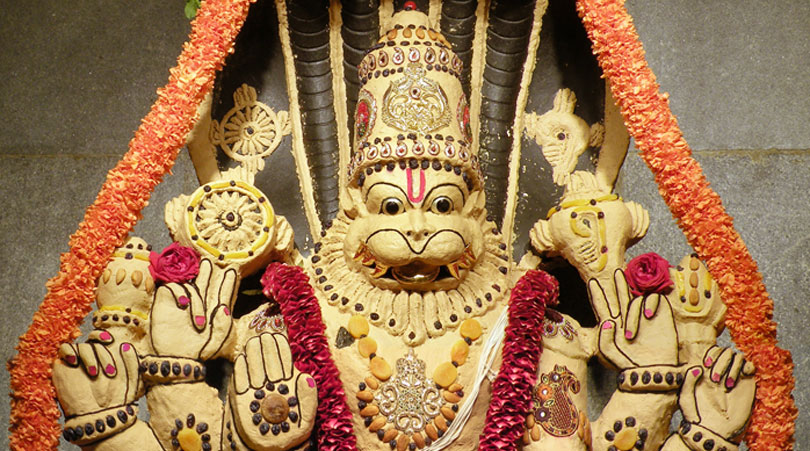
prahlada narasimha

The Supreme Lord is self-sufficient. He does not require anything from us and neither our service. If He so desires, He can produce millions of living entities through His energies. It is because Krishna is so kind and merciful that He gives everyone the opportunity to serve Him, as though He required the service of His devotees. He is perfect in Himself. However, if we give Him service wholeheartedly and sincerely, then, by His mercy, we shall make advancement. Basically Krishna wants our love and our interest. And as per our love towards Him, He reciprocates.
Chandan Yatra is one such opportunity to engage lovingly in the service of the Lord. During this festival, to beat the blazing heat of the summer, the Lord’s body is anointed with sandalwood paste. Only once in a year devotees get this special darshan of Sri Prahlada Narasimha in Chandan Alankara. Starting from Ekadashi till the day before of Narasimha Jayanti, Lord will give darshan in Chandan Alankara.
Lot of devotees participate in Chandan Yatra services. They grind the sandalwood into a fine paste. If you wish to grind the sandal paste for Sri Prahlada Narasimha, please contact us.