

As a great devotee of Kṛṣṇa, King Parīkṣit was already liberated, but for clarification he was asking various questions of Śukadeva Gosvāmī. In the previous chapter, King Parīkṣit's question was, "What is the ultimate goal of the Vedas?" And Śukadeva Gosvāmī explained the matter, giving authoritative descriptions from the disciplic succession, beginning with Sanandana down to Nārāyaṇa Ṛṣi, Nārada, Vyāsadeva, and then he himself. The conclusion was that devotional service, or bhakti, is the ultimate goal of the Vedas. A neophyte devotee may question, "If the ultimate goal of life, or the conclusion of the Vedas, is to elevate oneself to the platform of devotional service, then why is it observed that a devotee of Lord Viṣṇu is generally not very prosperous materially, whereas a devotee of Lord Śiva is found to be very opulent?" In order to clarify this matter, Parīkṣit Mahārāja asked Śukadeva Gosvāmī: "My dear Śukadeva Gosvāmī, it is generally found that those who engage in the worship of Lord Śiva, whether in human, demoniac, or demigod society, become very opulent materially, although Lord Śiva himself lives just like a poverty-stricken person. On the other hand, the devotees of Lord Viṣṇu, who is the controller of the goddess of fortune, do not appear to be very prosperous, and sometimes they are even found to be living without any material opulence at all. Lord Śiva lives underneath a tree or in the snow of the Himalayan Mountains. He does not even construct a house for himself, but still the worshipers of Lord Śiva are very rich. Kṛṣṇa, or Lord Viṣṇu, however, lives very opulently, whether in Vaikuṇṭha or in this material world, but His devotees appear to be poverty-stricken. Why is this so?"

Mahārāja Parīkṣit's question is very intelligent. The two classes of devotees, namely the devotees of Lord Śiva and the devotees of Lord Viṣṇu, are always in disagreement. Even today in India these two classes of devotees still criticize each other, and especially in South India, the followers of Rāmānujācārya and the followers of Śaṅkarācārya hold occasional meetings for understanding the Vedic conclusion. Generally, the followers of Rāmānujācārya come out victorious in such meetings. So Parīkṣit Mahārāja wanted to clarify the situation by asking this question of Śukadeva Gosvāmī. That Lord Śiva lives as a poor man although his devotees appear to be very opulent, whereas Lord Kṛṣṇa or Lord Viṣṇu is always opulent, and yet His devotees appear to be poverty-stricken, is a situation which appears contradictory and puzzling to a discriminating person.
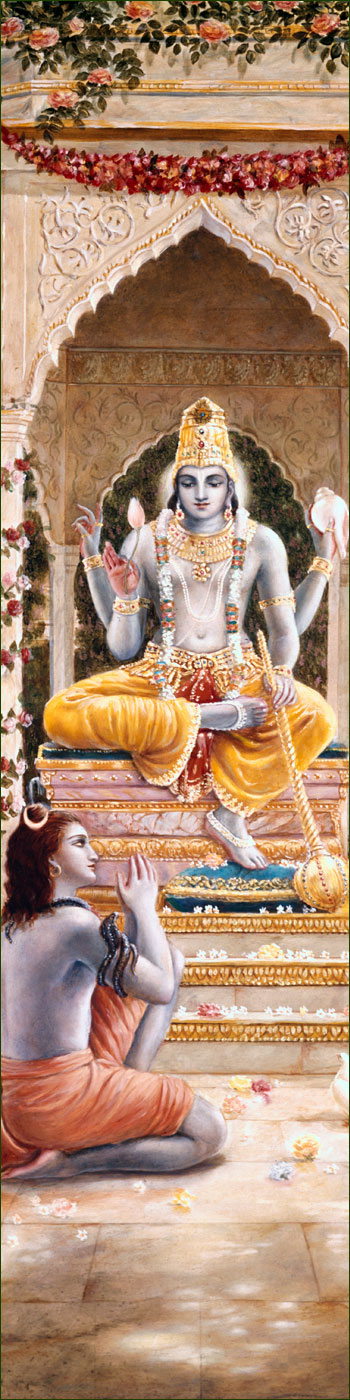 Śukadeva Gosvāmī began to reply to King Parīkṣit's inquiry about the apparent contradictions regarding the worship of Lord Śiva and that of Lord Viṣṇu. Lord Śiva is the master of the material energy. The material energy is represented by goddess Durgā, and Lord Śiva happens to be her husband. Since goddess Durgā is completely under the subjugation of Lord Śiva, it is to be understood that Lord Śiva is the master of this material energy. The material energy is manifested in three qualities, namely goodness, passion and ignorance, and therefore Lord Śiva is the master of these three qualities. Although he is in association with these qualities for the benefit of the conditioned soul, Lord Śiva is the director and is not affected. Although the conditioned soul is affected by the three qualities, Lord Śiva, because he is the master of these qualities, is not affected by them.
From the statements of Śukadeva Gosvāmī we can understand that the effects of worshiping different demigods are not, as some less intelligent persons suppose, the same as the effects of worshiping Lord Viṣṇu. He clearly states that by worshiping Lord Śiva one achieves one reward, whereas by worshiping Lord Viṣṇu one achieves a different reward. This is also confirmed in the Bhagavad-gītā: Those who worship the different demigods achieve the desired results which the respective demigods can reward. Similarly, those who worship the material energy receive the suitable reward for such activities, and those who worship the pitās receive similar results. But those who are engaged in devotional service or worship of the Supreme Lord, Viṣṇu or Kṛṣṇa, go to the Vaikuṇṭha planets or Kṛṣṇaloka. One cannot approach the transcendental region or paravyoma, the spiritual sky, by worshiping Lord Śiva or Brahmā or any other demigod.
Since this material world is a product of the three qualities of material nature, all varieties of manifestations come from those three qualities. With the aid of materialistic science, modern civilization has created many machines and comforts of life, and yet they are only varieties of the interactions of the three material qualities. Although the devotees of Lord Śiva are able to obtain many material acquisitions, we should know that they are simply collecting products manufactured by the three qualities. The three qualities are again subdivided into sixteen, namely the ten senses (five working senses and the five knowledge-acquiring senses), the mind, and the five elements (earth, water, air, fire and sky). These sixteen items are further extensions of the three qualities. Material happiness or opulence means gratification of the senses, specifically the genitals, the tongue and the mind. By exercising our minds we create many pleasurable things just for enjoyment by the genitals and the tongue. The opulence of a person within this material world is estimated in terms of his exercise of the genitals and the tongue, or, in other words, how well he is able to utilize his sexual

