Plz click this ad to support us

Click to Shop Online Now!

Why Snana Yatra is Celebrated?

Image result for snana yatra

A special bath of Jagannath takes place on the Purnima of Jyestha month (Devasnan Purnima), to commemorate the appearance day of Lord Jagannath.

According to Skanda Purana when Raja Indradyumna installed the wooden deities he arranged this bathing ceremony. This day considered to be the birth-day of Lord jagannath. Held in the full-moon day of the month of Jyestha this festival is also simultaneously held in all other important Puri, it attracts thousands of visitors and pilgrims from all over the country.
'Niladri Mohadaya', a religious text written in Orissan (Oriya) records the rituals of the festival. Sriharsa in his 'naisadhiya Charita' (XV.89) also refers to this festival of Purushottama. This bathing ceremony has a speciality. As this festival does not find mention in the early religious texts, it is believed to be a tribal ceremony. Lord.Jagannath in His early form was being worshipped as Nilamadhava by a Savara chief called Viswabasu. The story is nicely told in the drama Jagannath Priyan natakam. Till now it is the Daitas and Savars (tribals) who have the exclusive right to conduct the festival. The tribals called Saoras (of southern Orissa) still perform a rite to bath their Deities ceremonially on the last day of the month of Jyestha. For this they collect water from remote Jungles where it remains untouched even by the shadow of the animals.

On the previous day of Snana Yatra the images of Jagannath, Balabhadra and Subhadra along with the image of Sudarshana are ceremonially brought out from the sanctum in a procession to the Snana-vedi (Bathing pandal). This special pandal in the temple precinct of Puri is called Snana Mandap. It is at such a height that visitors standing outside the temple also gate a glimpse of the Deities.
On the fourteenth day (Chaturdashi - the day before the bathing - Purnima) when the Deities are taken out in procession, the whole process is called Pahandi or Pahandi vijay. Scholars have given different interpretations of the term ('Pahandi'). Some opine that it has been derived from the term 'Praspanda' meaning movement. Some others are inclined to interpret it as derivation from Pandya vijaya.

For the festival the the Snana Vedi (bathing platform) is well decorated with traditional paintings of trees and gardens. Flags and toranas (arches strung with mango leaves) are also put up. The Deities are profusely decorated with flowers. All kinds of perfumes such as Dhupa (incense), Aguru (oils) etc. are then offered. As the 'Pahandi' of the Deities takes place to the accompaniment of music and beating of various indigenous drums. Thousands of devotees jostle and crave for a look at the Deities in procession.


In Puri the bathing procedure is as follows: After Mangala Arati, the Suaras and Mahasuaras go in a ceremonial procession to fetch water from Suna Kua (Golden well) in one hundred and thirty, vessels of copper and gold. All of them cover their mouths with a piece of cloth so as not to contaminate it even with their breath. Then all the vessels filled with water are preserved in the Bhoga Mandap. The Palla pandas (a class of Brahmin priests) then purify the water with Haridra (turmeric), Java (whole rice), Benachera, Chandan, Aguru, flowers, perfumes and medicinal herbs.
The bathing festival takes place during the morning hours of the purnima tithi. The filled vessels are carried from Bhoga Mandap to the Snana Vedi by the Suaras in a long single-line procession. This

Snana Yatra ~ 9th June 2017

On this full-moon day, sixteen days before Ratha- yatra, Lord Jagannatha is bathed. He becomes sick and is confined to rest for fourteen days. He is then offered special care until He comes out for Ratha-yatra.

Image result for snana yatra

A special bath of Jagannath takes place on the Purnima of Jyestha month (Devasnan Purnima), to commemorate the appearance day of Lord Jagannath.
According to Skanda Purana when Raja Indradyumna installed the wooden deities he arranged this bathing ceremony. This day considered to be the birth-day of Lord jagannath. Held in the full-moon day of the month of Jyestha this festival is also simultaneously held in all other important Puri, it attracts thousands of visitors and pilgrims from all over the country.

'Niladri Mohadaya', a religious text written in Orissan (Oriya) records the rituals of the festival. Sriharsa in his 'naisadhiya Charita' (XV.89) also refers to this festival of Purushottama. This bathing ceremony has a speciality. As this festival does not find mention in the early religious texts, it is believed to be a tribal ceremony. Lord.Jagannath in His early form was being worshipped as Nilamadhava by a Savara chief called Viswabasu. The story is nicely told in the drama Jagannath Priyan natakam. Till now it is the Daitas and Savars (tribals) who have the exclusive right to conduct the festival. The tribals called Saoras (of southern Orissa) still perform a rite to bath their Deities ceremonially on the last day of the month of Jyestha. For this they collect water from remote Jungles where it remains untouched even by the shadow of the animals.

On the previous day of Snana Yatra the images of Jagannath, Balabhadra and Subhadra along with the image of Sudarshana are ceremonially brought out from the sanctum in a procession to the Snana-vedi (Bathing pandal). This special pandal in the temple precinct of Puri is called Snana Mandap. It is at such a height that visitors standing outside the temple also get a glimpse of the Deities.

Image result for snana yatra

On the fourteenth day (Chaturdashi – the day before the bathing – Purnima) when the Deities are taken out in procession, the whole process is called Pahandi or Pahandi vijay. Scholars have given different interpretations of the term ('Pahandi'). Some opine that it has been derived from the term 'Praspanda' meaning movement. Some others are inclined to interpret it as derivation from Pandya vijaya.
For the festival the the Snana Vedi (bathing platform) is well decorated with traditional paintings of trees and gardens. Flags and toranas (arches strung with mango leaves) are also put up. The Deities are profusely decorated with flowers. All kinds of perfumes such as Dhupa (incense), Aguru (oils) etc. are then offered. As the 'Pahandi' of the Deities takes place to the accompaniment of music and beating of various indigenous drums. Thousands of devotees jostle and crave for a look at the Deities in procession.

In Puri the bathing procedure is as follows: After Mangala Arati, the Suaras and Mahasuaras go in a ceremonial procession to fetch water from Suna Kua (Golden well) in one hundred and thirty, vessels of copper and gold. All of them cover their mouths with a piece of cloth so as not to contaminate it even with their breath. Then all the vessels filled with water are preserved in the Bhoga Mandap. The Palla pandas (a class of Brahmin priests) then purify the water with Haridra (turmeric), Java (whole

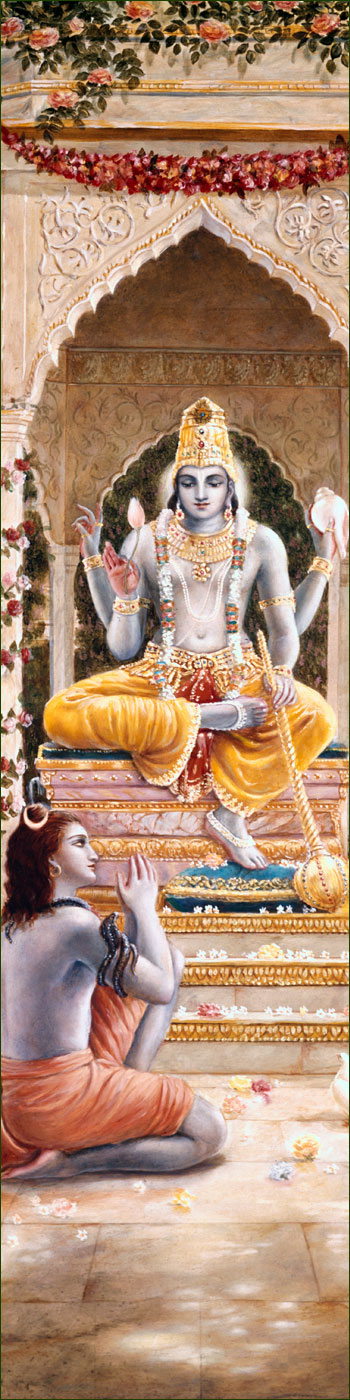
The Deliverance of Lord Śiva


As a great devotee of Kṛṣṇa, King Parīkṣit was already liberated, but for clarification he was asking various questions of Śukadeva Gosvāmī. In the previous chapter, King Parīkṣit's question was, "What is the ultimate goal of the Vedas?" And Śukadeva Gosvāmī explained the matter, giving authoritative descriptions from the disciplic succession, beginning with Sanandana down to Nārāyaṇa Ṛṣi, Nārada, Vyāsadeva, and then he himself. The conclusion was that devotional service, or bhakti, is the ultimate goal of the Vedas. A neophyte devotee may question, "If the ultimate goal of life, or the conclusion of the Vedas, is to elevate oneself to the platform of devotional service, then why is it observed that a devotee of Lord Viṣṇu is generally not very prosperous materially, whereas a devotee of Lord Śiva is found to be very opulent?" In order to clarify this matter, Parīkṣit Mahārāja asked Śukadeva Gosvāmī: "My dear Śukadeva Gosvāmī, it is generally found that those who engage in the worship of Lord Śiva, whether in human, demoniac, or demigod society, become very opulent materially, although Lord Śiva himself lives just like a poverty-stricken person. On the other hand, the devotees of Lord Viṣṇu, who is the controller of the goddess of fortune, do not appear to be very prosperous, and sometimes they are even found to be living without any material opulence at all. Lord Śiva lives underneath a tree or in the snow of the Himalayan Mountains. He does not even construct a house for himself, but still the worshipers of Lord Śiva are very rich. Kṛṣṇa, or Lord Viṣṇu, however, lives very opulently, whether in Vaikuṇṭha or in this material world, but His devotees appear to be poverty-stricken. Why is this so?"


Mahārāja Parīkṣit's question is very intelligent. The two classes of devotees, namely the devotees of Lord Śiva and the devotees of Lord Viṣṇu, are always in disagreement. Even today in India these two classes of devotees still criticize each other, and especially in South India, the followers of Rāmānujācārya and the followers of Śaṅkarācārya hold occasional meetings for understanding the Vedic conclusion. Generally, the followers of Rāmānujācārya come out victorious in such meetings. So Parīkṣit Mahārāja wanted to clarify the situation by asking this question of Śukadeva Gosvāmī. That Lord Śiva lives as a poor man although his devotees appear to be very opulent, whereas Lord Kṛṣṇa or Lord Viṣṇu is always opulent, and yet His devotees appear to be poverty-stricken, is a situation which appears contradictory and puzzling to a discriminating person.


Lord Shiva & VishnuŚukadeva Gosvāmī began to reply to King Parīkṣit's inquiry about the apparent contradictions regarding the worship of Lord Śiva and that of Lord Viṣṇu. Lord Śiva is the master of the material energy. The material energy is represented by goddess Durgā, and Lord Śiva happens to be her husband. Since goddess Durgā is completely under the subjugation of Lord Śiva, it is to be understood that Lord Śiva is the master of this material energy. The material energy is manifested in three qualities, namely goodness, passion and ignorance, and therefore Lord Śiva is the master of these three qualities. Although he is in association with these qualities for the benefit of the conditioned soul, Lord Śiva is the director and is not affected. Although the conditioned soul is affected by the three qualities, Lord Śiva, because he is the master of these qualities, is not affected by them.

From the statements of Śukadeva Gosvāmī we can understand that the effects of worshiping different demigods are not, as some less intelligent persons suppose, the same as the effects of worshiping Lord Viṣṇu. He clearly states that by worshiping Lord Śiva one achieves one reward, whereas by worshiping Lord Viṣṇu one achieves a different reward. This is also confirmed in the Bhagavad-gītā: Those who worship the different demigods achieve the desired results which the respective demigods can reward. Similarly, those who worship the material energy receive the suitable reward for such activities, and those who worship the pitās receive similar results. But those who are engaged in devotional service or worship of the Supreme Lord, Viṣṇu or Kṛṣṇa, go to the Vaikuṇṭha planets or Kṛṣṇaloka. One cannot approach the transcendental region or paravyoma, the spiritual sky, by worshiping Lord Śiva or Brahmā or any other demigod.

Since this material world is a product of the three qualities of material nature, all varieties of manifestations come from those three qualities. With the aid of materialistic science, modern civilization has created many machines and comforts of life, and yet they are only varieties of the interactions of the three material qualities. Although the devotees of Lord Śiva are able to obtain many material acquisitions, we should know that they are simply collecting products manufactured by the three qualities. The three qualities are again subdivided into sixteen, namely the ten senses (five working senses and the five knowledge-acquiring senses), the mind, and the five elements (earth, water, air, fire and sky). These sixteen items are further extensions of the three qualities. Material happiness or opulence means gratification of the senses, specifically the genitals, the tongue and the mind. By exercising our minds we create many pleasurable things just for enjoyment by the genitals and the tongue. The opulence of a person within this material world is estimated in terms of his exercise of the genitals and the tongue, or, in other words, how well he is able to utilize his sexual

Krishna story: How Prahlada Became a Devotee of Nrsimhadeva

Krishna story: How Prahlada Became a Devotee of Nrsimhadeva

This section of the Hari-bhakti-vilasa 14.418-441, (the glories of Nrsimha-caturdasi) quoting from Brhan Nrsimha Purana , describes who Prahlada Maharaja was in his previous life and how he became a Narasimha Bhakta.
Prahlada said: O Supreme Lord! I bow down to You. O Lord Nrsimhadeva, I offer my obeisances to You. I am Your devotee. O Lord of lords, I now express to You my heartfelt inquiry. O Lord, how did I develop such intense devotion for You? O my Lord, kindly tell me-how did I become Your exalted devotee?

Image result for narasimha prahlada

Lord Narasimhadeva said: O greatly learned one! O my son, listen carefully as I explain to you the reason for your devotion to Me that has made you very dear to Me.
In the ancient times, you were born as a brahmana but you did not study any of the scriptures. Your name was Vasudeva and you became attached to a prostitute.
In that birth, you became so attached to a prostitute that you did not bother to perform any pious activity, except for a single vow in relation to Me. As a result of observing that vow, you developed exalted devotion for Me.

Prahlada then said: O Lord Nrsimhadeva! O Acyuta! O Supreme Lord, who was my father in that lifetime? What was my duty? How did I observe Your vow, even though I was attached to a prostitute? Kindly explain all this to me in detail.
Lord Nrsimhadeva said: In ancient times, there was a brahmana who was well-versed in the Vedic literature. He lived in the city of Avantipura and was known as Vasu Sarma.
This pious brahmana used to perform fire sacrifice every day. He was very expert in performing all kinds of Vedic rituals and as such, he would satisfy the best of demigods by performing the agnistoma sacrifice. In that state of living, he did not commit any sinful activity.

His wife was very pious and humble. She was famous throughout the three worlds. She was chaste, expert in performing all kinds of pious activities, and always eager to serve her husband.
That exalted brahmana begot five sons within the womb of his wife. These sons were very pious, learned, and devoted to their father. Among them, you were the youngest and you became attached to a prostitute.
Due to being attached to a prostitute, you became accustomed to drinking wine and performing other sinful activities, so that you never engaged in the study of the Vedas.
You spent most of your time at the house of the prostitute. One day, however, you and her quarreled.
Because of that quarrel, you missed your meal that day and as a result, you unknowingly observed a sacred vow in relation to Me.
Because of that quarrel with the prostitute, you did not sleep the entire night. The prostitute also did not eat anything, nor did she sleep that night in your association.

Because of unknowingly observing this vow in relation to Me, throughout the entire day and night, both of you became purified and accumulated heaps of pious merit.
On the strength of observing this vow, the demigods are able to enjoy their lives in the heavenly planets. In order to acquire the power to create, Brahma had observed this vow.
Being empowered due to observing this vow in relation to Me, Brahma was able to create all moving and non-moving living entities. Mahadeva also observed this vow, so that he could kill the great demon, Tripurasura. It is a fact that by the strength of this vow, Siva was able to kill that formidable demon.

Many other demigods, ancient sages, and learned and pious kings, had previously followed this great vow in relation to Me.
By the influence of this vow, all of them attained the perfection of life. The prostitute also became devoted to Me and thereafter enjoyed great happiness within the three worlds. My dear child, it is for this reason that this vow in relation to Me is celebrated through the three worlds.
This vow came into existence just to deliver such rascals. O Prahlada, by the strength of that vow, you came to render devotional service unto Me.
In her next life, the prostitute was born in heaven as an Apsara and after enjoying life there immensely, she entered My supreme abode. O Prahlada, you will also return to My abode and enter into intimate communion with Me.

In order to propagate devotional service to Me, you have incarnated without Me. After completing the task of preaching the glories of devotional service, you will again enter My eternal abode.
Those who observe this supreme vow in relation to Me will never return to this material existence, even in hundreds and millions of kalpas.

Hari-bhakti-vilasa 14.418-441
BY: SHYAMASUNDARA DASA

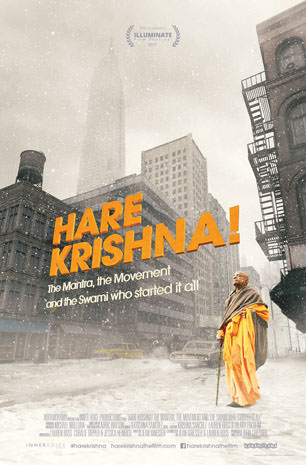
Hare Krishna Film Review


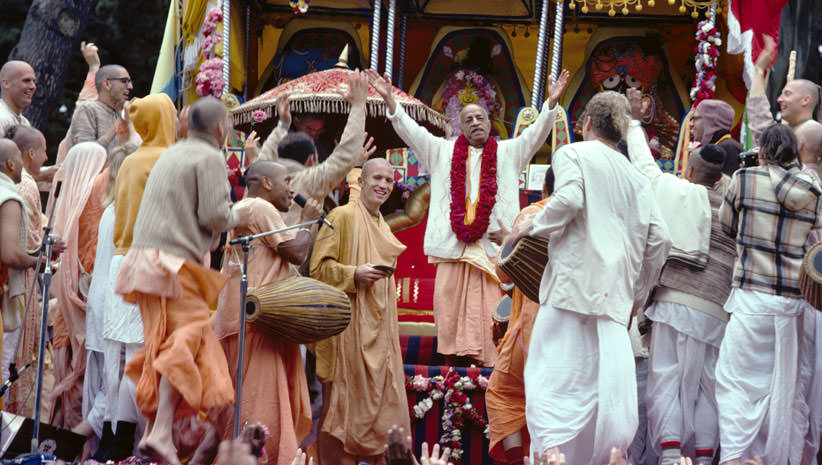
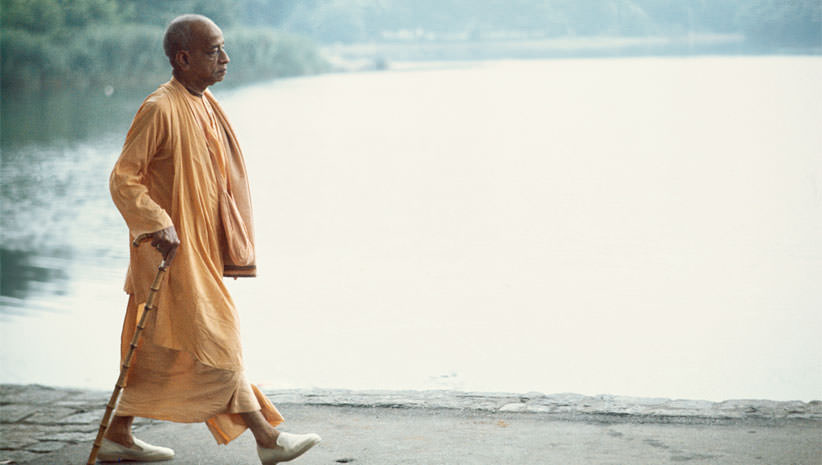
If His Divine Grace A.C. Bhaktivedanta Swami Prabhupada tried to enter the US from India today, chances are the spiritual master would be detained. But in 1964, the septuagenarian Vaishnava Swami was welcomed to the West with open arms and proceeded to detonate a transcendental love bomb on Manhattan’s Lower East Side that transformed the phenomenal world forever. This is the story told in the Hare Krishna! film documentary.
Prabhupada infiltrated the counterculture with the science and art of Bhakti (devotion) and swept a generation into his wake. With a universe of devotees at his feet, he spearheaded the worldwide Krishna Consciousness movement, rebranding the Sankirtan movement, and taking the Maha Mantra back to into the street. Like his predecessor from another Swami order, Paramahansa Yogananda, Prabhupada is the subject of a new feature documentary release. Awake! The Life of Yogananda, which essentially created a new market for spiritual films, as well as Monk With a Camera(2016) have both paved the way for this film Hare Krishna!

If Hare Krishna! film director John Griesser’s goal was to reintroduce the world to the magic of Prabhupada, he hit his mark. Hare Krishna! is the second coming of Prabhupada.
Griesser draws the viewer into to the magic of the Hare Krishna movement through an artfully crafted, seamless, multimedia medley, drawing from a wealth of existing archival elements including photographs, film, and video interviews combined with recreations, reenactments, and graphics to achieve a cinematic flow that takes you out of the theatre and into the moment.

Prabhupada’s vibration is found in every frame. In the film, we get sense of 1960s, American-hippy naiveté through Prabhupada’s 19th century, Colonial Indian sensibilities. We also understand the decidedly enlightened arc, immutable faith, and selfless contributions of an elevated spiritual being who arrived in Manhattan on a mission from his master with a few Sanskrit texts and not much else. In little more than a decade of his time remaining, he propelled Krishna Consciousness into the global mainstream and synthesized a vast library of sacred Sanskrit wisdom texts to their essence.


“If we chant this vibration of transcendental sound with devotion and with attention that is the highest type of meditation and devotion.” -A.C. Bhaktivedanta Swami Prabhupada
For more information on the film, visit Hare Krishna the Film

Dwaraka story: Arjuna chanting “Krishna Krishna” in dream!

One time Krishna and Arjuna returned to Dwarka.

Arjuna was handling the chariot, so when they reached Dwarka he was tired and went to the Guest House to sleep.

After a while, Mother Rukmini came to Krishna and announced that food was ready.

Krishna said that we have a guest at home and I will not eat till he is ready.

So Mother Rukmini went to wake up Arjuna.

When she got to his room, she was so surprised to see that each and every part, each and every pore of his body was chanting “Krishna Krishna” even as he was sleeping!!!

Seeing this amazing sight, she got transfixed and started clapping her hands.

Narada Muni showed up and told Krishna your food is getting cold; and then he went to wake up Arjuna.

When he saw the same sight, he too got transfixed and started playing his Veena.

Satyabhama then came to call the Lord to eat, and then she said she will go wake up Arjuna.

When she got to his room and saw him chanting in his sleep, Rukmini clapping and Narada Muni playing the Veena, she forgot about the food and started dancing.

Finally Lord Krishna decided to go and wake up Arjuna himself.

When He reached there and saw all of them, His heart started overflowing with love and He sat on the bed and started massaging the Feet of Arjuna.

Arjuna woke up with a start and said Lord what are you doing?????

The Lord said, you love me with each and every pore of your body, and this is why you are so dear to me!

Saying this, He warmly embraced Arjuna!

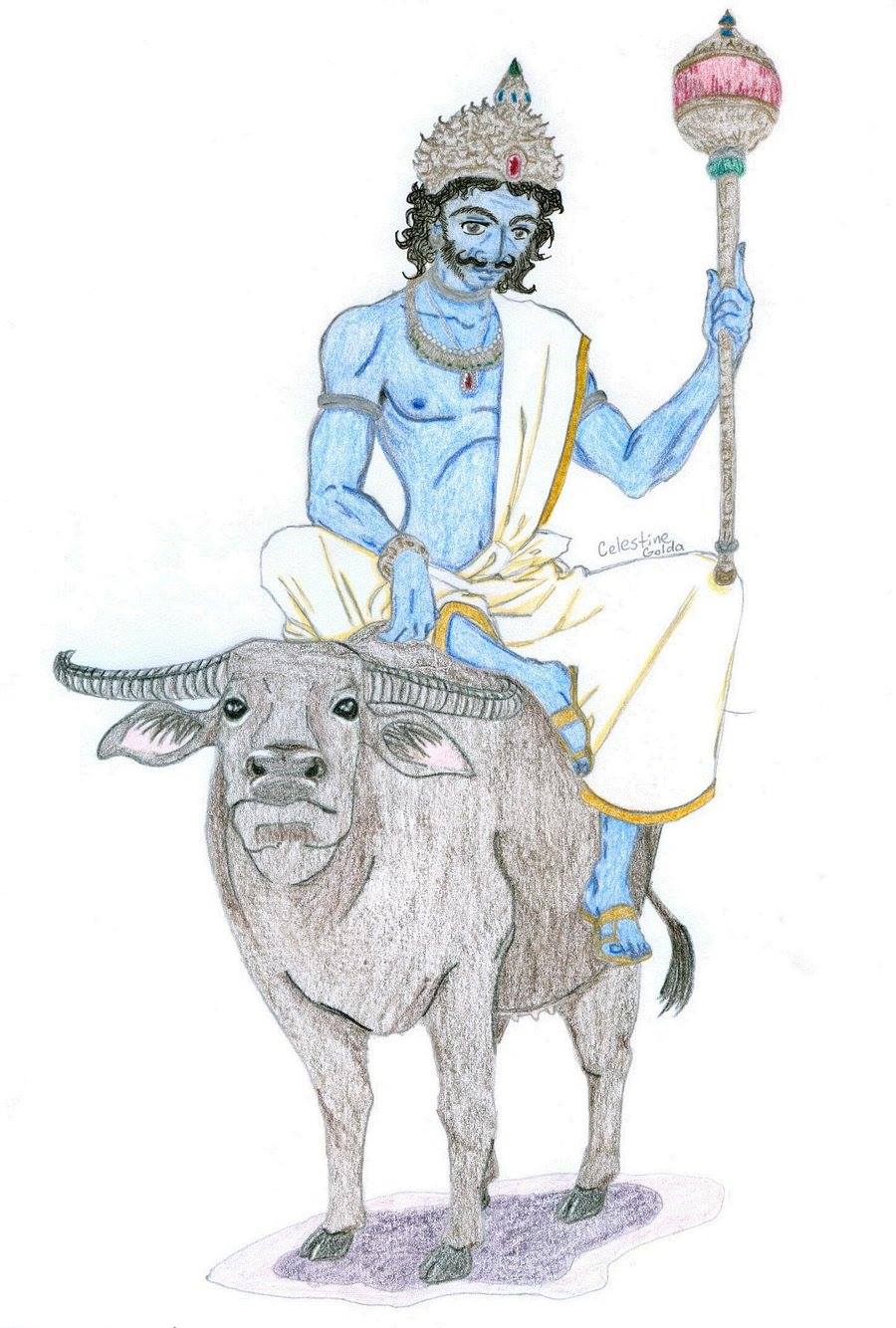
Important story: The four letters send by Yamaraja!!!!!


A man by the name of Amrita, living on earth, thought to himself that the one thing he feared most was death.
To avoid death, Amrita practised austerities and concentrated his mind upon Lord Yama, the Lord of Death.
Lord Yama was pleased and granted a vision to Amrita.
Lord Yama said: “My presence is only available to those who are about to die or already dead. Yet I granted you my vision while you are still living, pleased by your penances”.
Amrita said: “I ask this favour of you. If death is inevitable, I ask that if I am to die, then at least send me a letter before death so that I can make proper provision for my family before departure and also prepere myself for my next life with proper sadhana and worship of Krishna”
Lord Yama said, “Sure, I shall certainly do this. But as soon as you get the message, please set about making the preparations.”, and he disappeared.
Many years passed after this. Amritas hair began gradually to turn grey, but he was living a life full of sinful activities with not a thought about the fear of death.
He was pleased that so far no letters had arrived from the Lord of Death. Some Vaishnavas approached him and advised him to take to devotional service. He did not heed to their instructions as he thought so much time was left.
Some more years passed by. By this time Amrita had lost most of his teeth and the devotees came again to warn him about his imminent death. Still he did not bother because no letter has come from his friend Yama.
As the years rolled by, Amritas eyesight became dimmer. However he continued his sensual life thanking his friend Yamaraj for not sending any letter so far.
Some more years passed by. Amrita was now a very old man and with his back bent forward, he could not walk without the support of a walking stick. His skin was all wrinkled. One day he suffered a stroke and became paralysed. People said his condition was very critical.
But Amrita was still in a happy frame of mind, since he did not receive any letter from Yamaraj.
Then his destined end of life came and Lord Yama, the god of death, entered the room.
Amrita was startled and his mind was seized with fear.
Yamaraj said, “My friend, come now, you have suffered greatly.
Today I have come to take you with me.”
Amrita trembled in fear and said, ” My friend, you have betrayed me by breaking your boon. You have not sent me any letter as you promised. Now all of a sudden you are taking me from this world. You are a cheater”.
Lord Yama said, “Amrita! You spent all your life in sense indulgence with no interest in spiritual life. How then could you know the letters I sent you? Not one, but four letters I did send to you. But you ignored all of them.”
Amrita was greatly puzzled: “Four letters did you send? But not even one letter reached me. It is just possible that the postman/courier forgot to deliver it.”.
Lord Yama said, “My friend, do you think I will take a paper and pen and write a letter to you?
No, With your body as paper, with the pen of bodily changes I wrote my letters and time is the messenger who delivered those letters.
1) Years ago, your hair turned grey. That was my first letter. You ignored it.
2) Falling of your teeth was my second letter.
3) My third letter was sent to you when your eyesight failed.
4) The fourth message was when your body became paralysed.
You comfortably ignored all these letters. Now I have come not as your friend but as the dispenser of the Laws of God.”, and Yamaraj tied the rope around Amrita’s neck and pulled it hard.
People around Amrita said, “Amrita is now dead”.
Moral of the story:
So when the body is young and hale and when we don’t get any letter from Yamaraj, we should start our preparations for facing his lethal blow.
When we completely ignore his letters, then we come under his control.
Different people are afraid of different things in life and one person’s object of fear is not an object of fear for another person.
However in general, fear of death is common to all. Some people may boast that they are not scared of death.
However when they get some fatal disease which paralyse them or in case of dangers, the fear of death will be clearly visible in their eyes.
There is no material solution to this attack of Yamaraj and his punishments after death.
Though death is formidable and unconquerable, Sripada Sankaracharya, one of the great acharyas of the Vedantic tradition, gives a very simple solution to avoid interview with Yamaraj.
In his famous work “Bhaja Govindam” appears the following sloka.
bhagavad gita kinchit adeeta / ganga jala lava kanika peetaa
sakrdapyena muraari samarca / kriyate tasya yamena sasarcaa
“If a person reads little of Bhagavad Gita, takes a little drop of Ganges water and performs worship to Murari (Sri Krishna) atleast once in his lifetime, then he does not have to face an interview with Yamaraj.”
In the Bhagavata Purana (6.3.29), Yamaraj himself identifies who are the candidates for his punishment.
jihvaa na vakti bhagavad-guna-naamadheyam
cetas ca na smarati tac-caranaaravindam
krishnaya no namati yac-chira ekadapi
taan aanayadhvam asato ‘krita-vishnu-krityaan
“My dear servants, please bring to me only those sinful persons who do not use their tongues to chant the holy name and qualities of Krishna, whose hearts do not remember the lotus feet of Krishna even once, and whose heads do not bow down even once before Lord Krishna. Send me those who do not perform their duties toward Vishnu, which are the only duties in human life. Please bring me all such fools and rascals.”
Srila Prabhupada’s program of chanting and hearing and offering obeisances to the Supreme Lord will empower us to escape the punishment of Yamaraj who is otherwise unconquerable.
Hare Krishna, Hare Krishna, Krishna Krishna, Hare Hare
Hare Rama, Hare Rama, Rama Rama, Hare Hare.
PS: I humbly request all the devotees to please forward and share this moral / instructive stories they hear so that everyone can be benefited by hearing about Krishna and his dear devotees.